
It’s easy to become discouraged if you have an average or below average income. Saving for retirement is normally more difficult with a lower income; a greater portion of your income is going to necessities like shelter, transportation, and food, and less is available to be invested for retirement. Financial traps like high-interest credit card debt, 84-month car loans, and buy now, pay later services are more likely to draw you in if your income is lower, which will then make your situation worse.
Those who make less and will spend less in retirement naturally won’t need to save as much for retirement. However, we can even take it a step further: those with average or below average incomes might not need to save as high of a percentage of their income for retirement. It’s already difficult to invest 25% of your income for retirement, even more so if you have a lower income. If you can achieve a long and successful retirement while saving less, retirement may seem more possible and within reach. So how much do you need to save for retirement if you have an average or below average income?
How much should you save for retirement?
Determining how much you should invest for retirement is as easy as solving a basic math problem. You just need to know how much you will spend in retirement (including taxes), how long you’ll live, what age you want to retire, how much your investments will earn, other sources of retirement income, the rate of inflation throughout your retirement, and your withdrawal rate. Some of these variables are known and some are unknown, but we can estimate these unknown variables to the best of our knowledge to determine approximately how much you should be investing.
To determine how much you will spend in retirement, start with your current spending and add or subtract expenses that may change in retirement. For example, healthcare expenses could go up if you have chronic health problems and no longer have great health insurance coverage. Housing expenses may decrease significantly if you pay off your mortgage before retirement. Studies show that, on average, those who are retired spend about 25% less than those who are working.
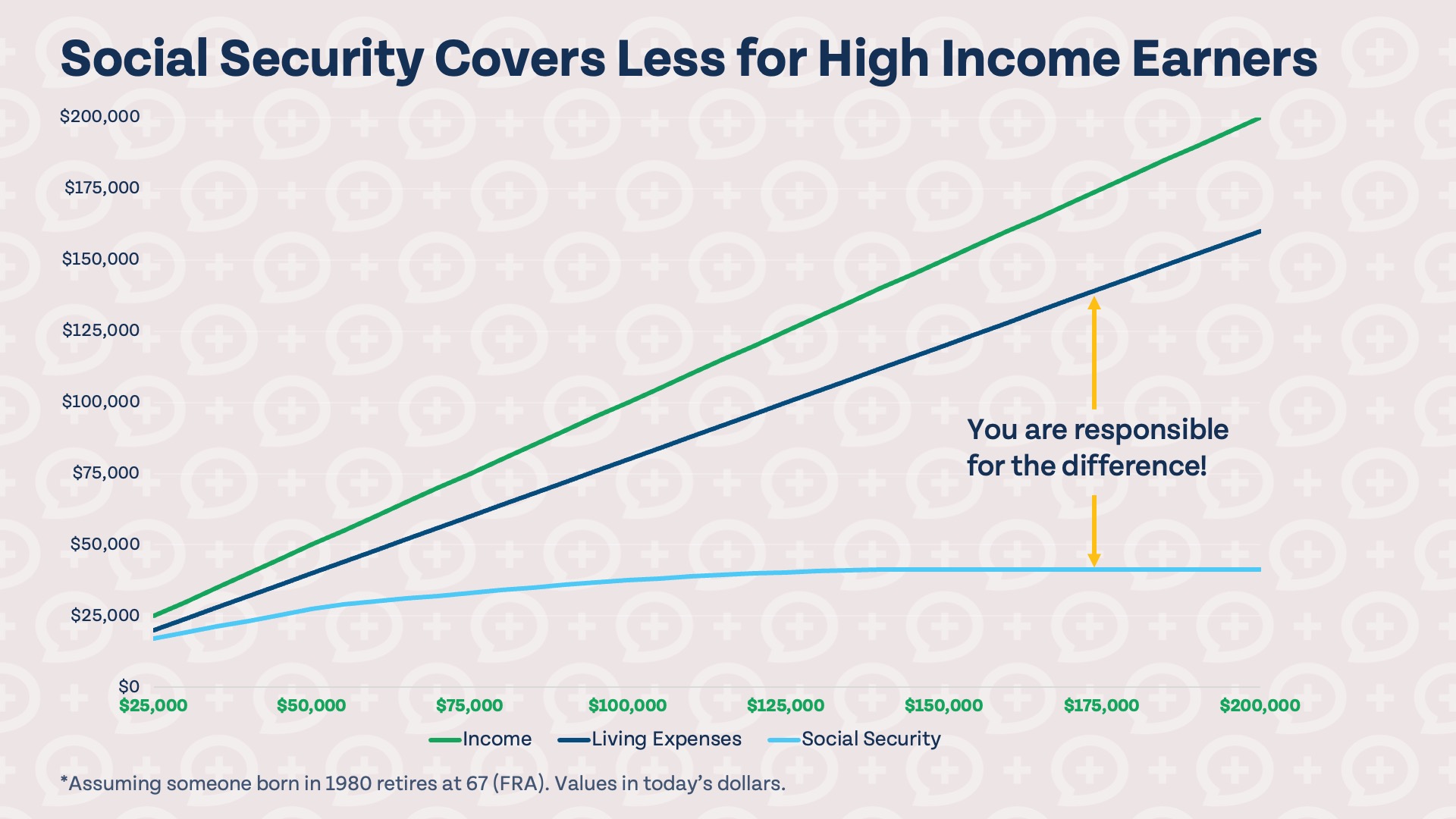
If you have a pension or will receive Social Security income, make sure you subtract them from your estimated expenses to get an accurate representation of what you will need to save. While pensions are few and far between, most retired Americans are receiving Social Security, and it actually covers more of your living expenses the less you make.
Life expectancy can be estimated based on how long your ancestors lived, any health conditions you have that may limit your life expectancy, your overall wellbeing, and continued medical advancements that could increase overall life expectancy. Unless you have strong evidence to the contrary, it’s best to assume you will live a long, happy life. In our Know Your Number course, the baseline life expectancy assumption is that you will live to age 95.
The age you want to retire may be known down to the exact date if you are closer to retirement, or it could be more of a guess if you are younger. It’s best to be more conservative here, too: if you think you want to retire between 55 and 60, see what you would need to save for retirement to be possible at age 55.
Investment returns can be estimated based on historical market returns and how your portfolio will change as you get older. Typically the further you are from retirement, the more risk you can take in your portfolio, which raises your expected returns. Those closer to retirement usually have lower expected returns, but less variability in those returns.
Inflation is another variable that can’t be known in advance, but can be estimated based on current and historical inflation data. After a spike following the COVID-19 pandemic, inflation is now back under 3% and many retirement calculators assume a long-term inflation rate of around 2% to 4%. Our Know Your Number course baseline assumption is 3%.
Your withdrawal rate can vary over your retirement. Some years in retirement may have a higher withdrawal rate than other years. Those who retire earlier will need their money to last for longer and therefore will have a lower withdrawal rate. Assuming a life expectancy of 95, standard withdrawal rates are 4% at 65+, 3.5% at ages 55-64, 3.0% at ages 45-54, and 2.5% if under age 45.
Retirement savings case study
I want to put it all together and prove just how achievable retirement is with an average income by showing a sample retirement using our Know Your Number course and realistic numbers. According to the latest available Federal Reserve data, median individual income in the US is currently $45,140. In a two-income household, that would be $90,280. We’ll assume this couple will spend 75% of their income in retirement, so their initial income need is $67,710 per year in today’s dollars.
Let’s run two simulations here, first without any Social Security income and then one with Social Security. We’ll assume they are both 30 years of age with nothing currently saved and want to retire at 65. All other assumptions, including rate of return, inflation, and life expectancy, will be the baseline assumptions from Know Your Number.
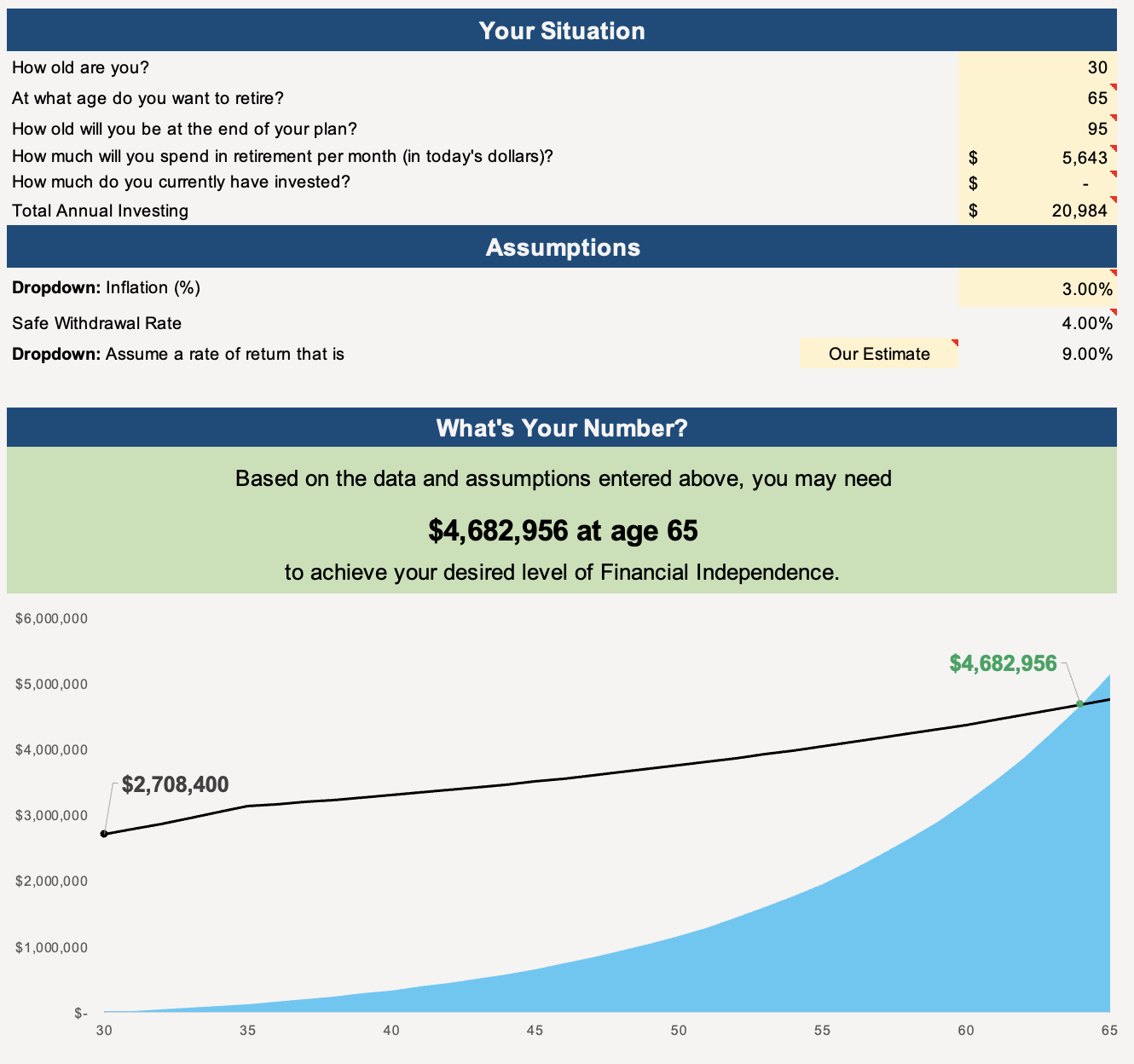
To achieve their desired retirement, they will need to invest about $1,750 per month, or 23.2% of their gross income. That lines up quite closely with our 25% investing guideline, but assumes they are not receiving any Social Security and don’t currently have anything invested for retirement.
Let’s take a look at how much they would need to invest if they expected to receive Social Security. According to the Social Security Administration, someone age 30 that makes $45,140 today will receive $1,687 per month in benefits, in today’s dollars, if they retire at 65. That means a couple that each made that amount would receive $3,374 per month or $40,488 per year, which reduces their income need in retirement from $67,710 to $27,222. Let’s see how much they would need to save to achieve that amount of retirement income.
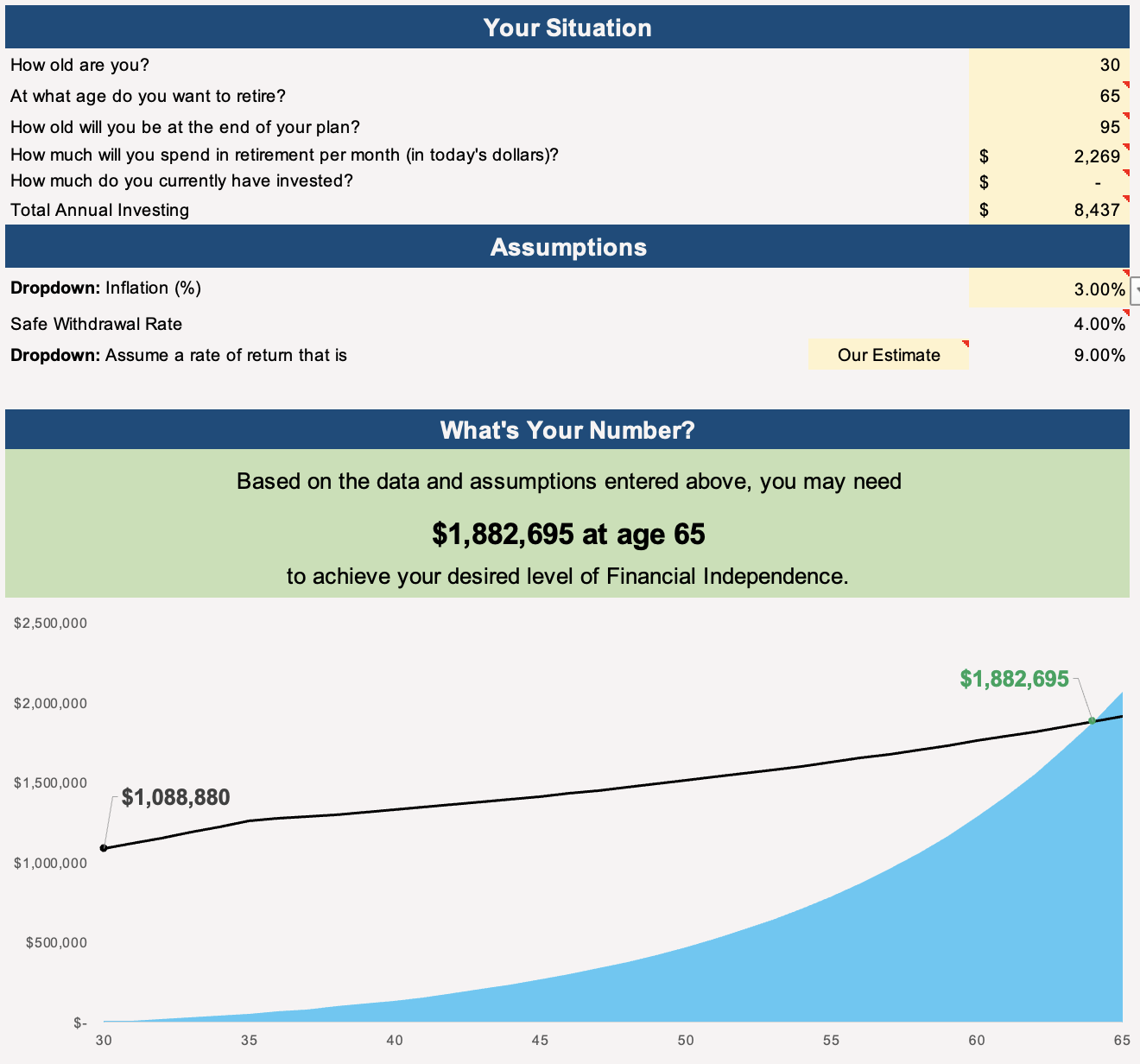
To reach their retirement goal, they need to save just $8,437 per year or $703 per month, which is only 9% of their gross income. Retirement is very possible even with an average or below average income, and it doesn’t necessarily require a 25% savings rate, but the more you are able to save, the greater your flexibility.
Let’s assume this couple is able to save the amount required to meet their goal without accounting for Social Security, which was 23% of their income. If they are able to spend less before they begin taking Social Security at age 65, they could retire over 10 years earlier than they expected.
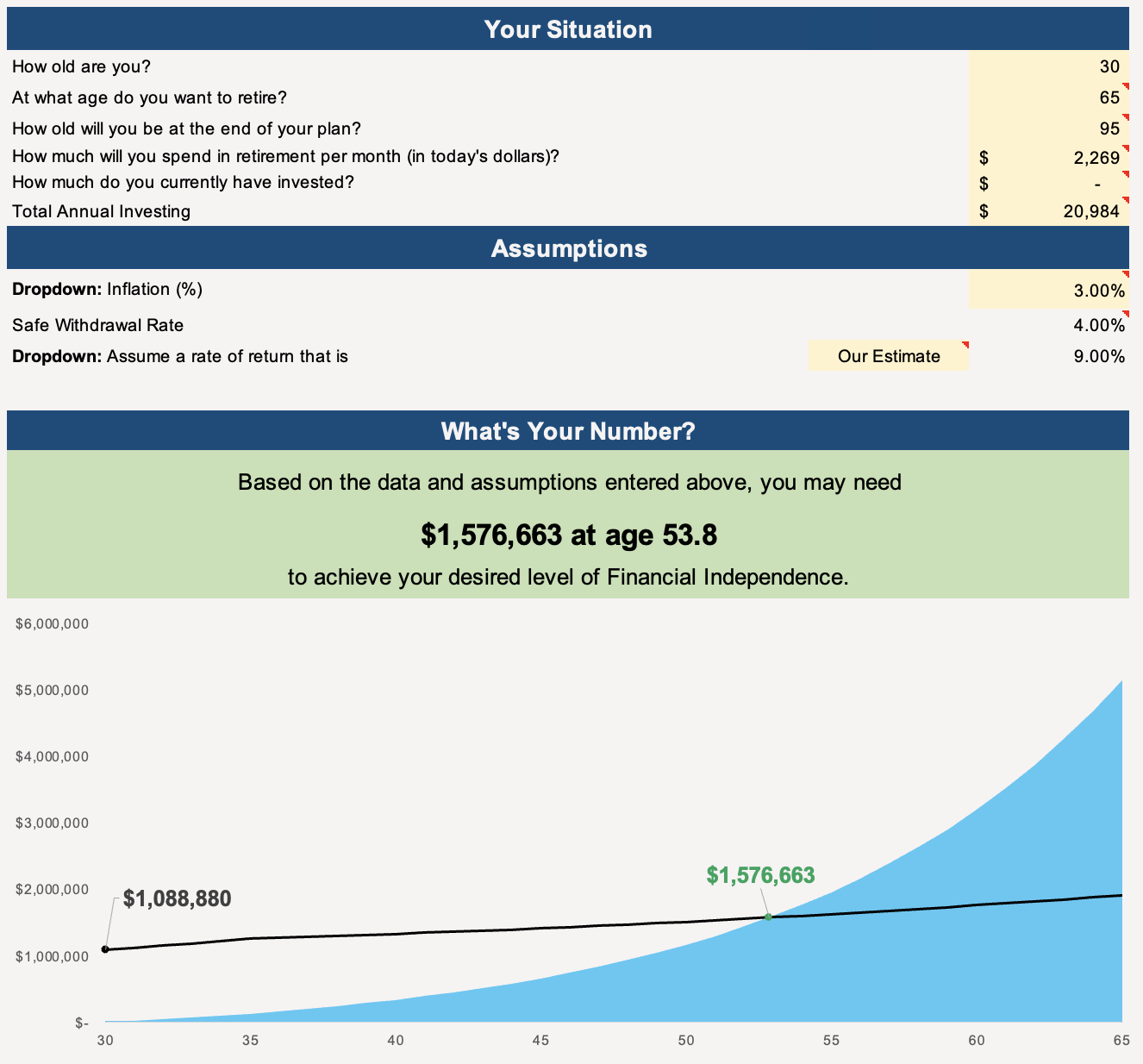
Retiring early isn’t the only option. They could choose to spend more in retirement or work less hours now. Investing more for retirement now gives you flexibility in the future, but the opposite is also true: investing less for retirement now means you will have less flexibility in the future.
Retirement is very possible even if you have a lower income. In this case study, we assumed a couple with an average income reached age 30 without saving a single dollar for retirement. To cover their full spending needs in retirement, they would need to save 23% of their gross income. That may be difficult, but is certainly not impossible. After accounting for their expected Social Security benefits, they would only need to invest 9% of their income for retirement. However, saving more could help cover shortfalls related to Social Security uncertainty, give them the flexibility to retire earlier, or allow them to spend more in retirement.
Experiencing a long, happy, and successful retirement is a possibility for everyone, not just those with higher incomes. It may even be possible if you are unable to invest 25% of your income. To increase your chances of success, start saving for retirement as early and possible and invest as much as you can.