Last Updated
October 1, 2026
Read Time
Share
401(k) plans are one of the most popular retirement savings vehicles in America and can help you build a tremendous amount of tax-advantaged wealth. Not all 401(k) plans are created equal, so it’s important to understand the intricacies of your plan to know how much you should contribute, when employer contributions will be yours to keep, different contribution types, 401(k) pitfalls, and more.
What is a 401(k)?
Copy link to this section: What is a 401(k)?
Copied the URL to your clipboard!
Copy link to this section: What is a 401(k)?
Copied the URL to your clipboard!
The 401(k) was created by The Revenue Act of 1978 that allowed employees to choose to receive a portion of their income as deferred compensation. It wasn’t until later in 1981 that major companies adopted 401(k) plans, and the rest is history. By the end of the very next year, 1982, about half of all large employers in the country offered 401(k) plans to their employees. Today, about two out of every three workers have access to 401(k) plans, while only 15% of private workers have a pension (pensions were the more popular retirement plan before 401(k)s were introduced).
Want to see how much every dollar invested in your 401(k) could become by age 65? Check out our Money Guy Wealth Multiplier tool.
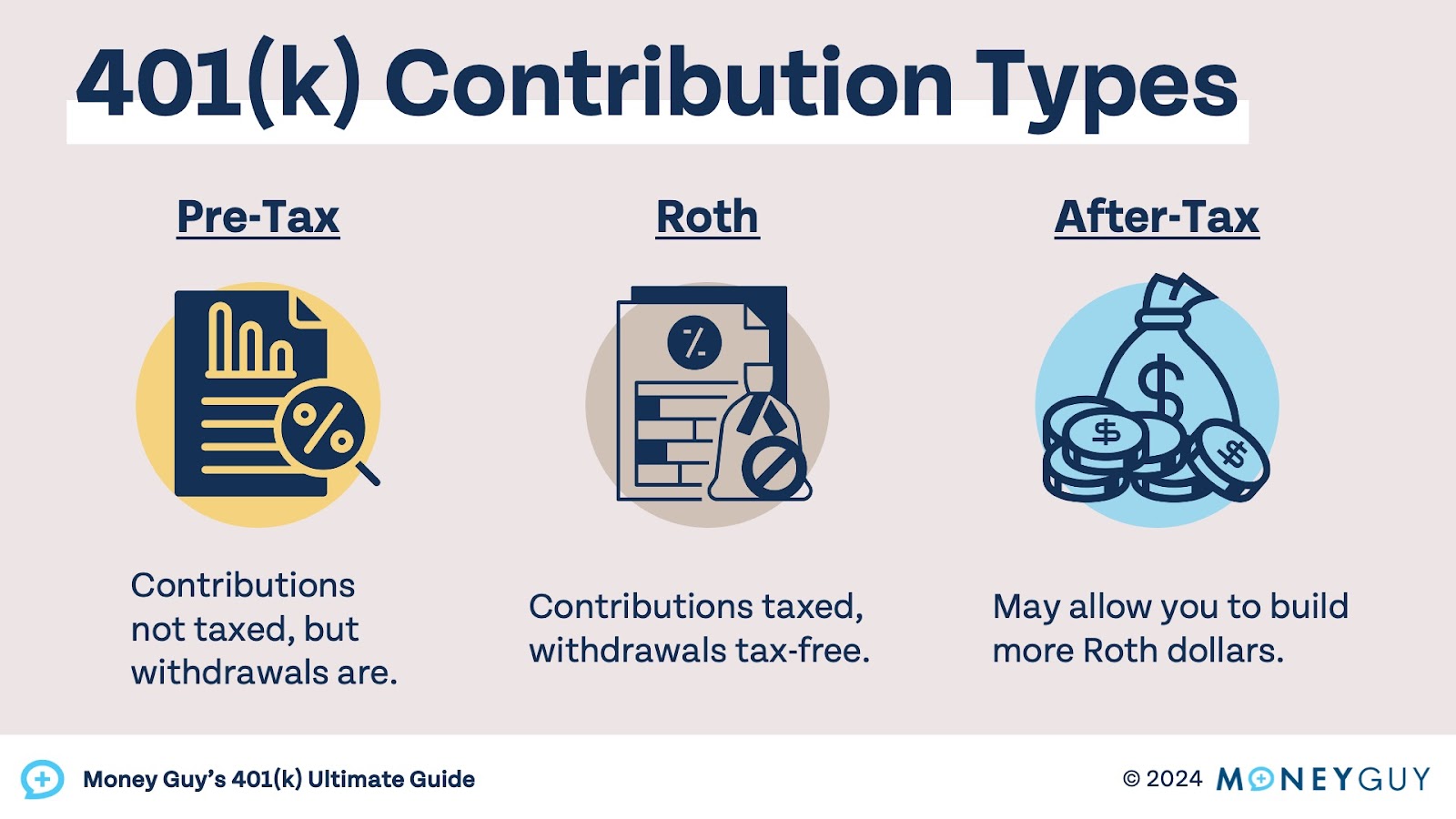
Within a 401(k) plan, employees may have the option of making pre-tax contributions or Roth contributions. Pre-tax contributions are not taxed initially, but upon distribution in retirement. Roth contributions are taxed initially, but growth is tax-free and qualified distributions are tax-free in retirement. Not all employers offer a Roth option, but about 93% of employers that sponsor a 401(k) plan now allow Roth contributions. Employer contributions usually go into the pre-tax side of your 401(k), but new legislation allows employees to choose for those contributions to go into the Roth portion of their 401(k). However, the employee is responsible for the tax if employer contributions are elected into the Roth portion of their 401(k).
Share image


Those who are self-employed may still be able to utilize a 401(k) to save for retirement. Solo 401(k) plans are for business owners with no employees. Users of solo 401(k)s may make Roth or pre-tax contributions just like with a regular 401(k).
2026 contribution limits
Copy link to this section: 2026 contribution limits
Copied the URL to your clipboard!
Copy link to this section: 2026 contribution limits
Copied the URL to your clipboard!
The contribution limits of 401(k) and solo 401(k) plans are the same; the employee contribution is limited to $24,500 in 2026 (with an additional $8,000 allowed for those 50 and older, or a super catch-up contribution of $11,250 if you are between the ages of 60 and 63).
The combined employee and employer limit, known as the annual additions limit, is currently $72,000. Since those with a solo 401(k) are both employee and employer, they may be able to utilize the entire $72,000 limit if they have the income to do so. Traditional employees may also be able to contribute up to the annual additions limit of $72,000 to their 401(k) if their employer allows after-tax contributions (which may be used to make what are called mega backdoor Roth contributions).
It’s important to note that the catch-up and super catch-up contribution limits are in addition to the combined employee and employer limit.
401(k) limits by year
| Limit | 2024 | 2025 | 2026 |
|---|---|---|---|
| Salary deferral limit | $23,000 | $23,500 | $24,500 |
| Annual additions limit | $69,000 | $70,000 | $72,000 |
| Catch-up (age 50+) | $7,500 | $7,500 | $8,000 |
| Super catch-up (ages 60–63) | N/A | $11,250 | $11,250 |
401(k) plans are the most popular employer-sponsored retirement plan, but they are not the only plans. Instead of a 401(k), you may have a 403(b) plan, 457 plan, SIMPLE IRA, SEP IRA, TSP, or a different type of plan. Many of these different types of plans are offered to non-profit or government employees. These plans work similarly to 401(k) plans, but may have different contribution limits, investment options, and rules depending on the plan. Employers may also offer stock ownership plans, such as ESPPs or ESOPs.
How much should I contribute?
Copy link to this section: How much should I contribute?
Copied the URL to your clipboard!
Copy link to this section: How much should I contribute?
Copied the URL to your clipboard!
Maximizing your 401(k) or other employer-sponsored plan is Step 6 of our Financial Order of Operations, but this actually isn’t a step everyone needs to complete. Before you think about maximizing your 401(k), you should be maximizing your Roth IRA and HSA, if you are able to contribute to those accounts.
Assuming you don’t get an employer match and haven’t yet contributed to your 401(k) plan, maximizing your Roth IRA and HSA alone means you will be investing $11,900 annually for your retirement (based on 2026 contribution limits). If you are making, say, $40,000 per year, you would be investing over 25% for retirement by maximizing just your Roth IRA and HSA and may not need to contribute to your 401(k) at all.
If you make $100,000, maxing your Roth and HSA would put you at about a 12% savings rate. To get to 25%, you would need to contribute a little over $13,000 to your 401(k). A healthy contribution, but still not maximizing your 401(k) plan.
Maximizing your 401(k) makes sense when you have a high income and need to invest more to reach the 25%+ retirement investing goal. Consider Step 6 of the FOO complete if you are able to invest 25% of your income for retirement, regardless of whether or not you are maximizing your 401(k) plan.
What if maximizing my 401(k) isn’t enough?
If you have a high income, maximizing your 401(k) may not be enough to meet the 25% retirement investing goal. You can use a taxable brokerage account to meet that 25%, but before you contribute there, check to see if your employer allows you to use what’s called the mega backdoor Roth strategy.
To use this strategy, your 401(k) plan would need to allow non-Roth after-tax contributions as well as in-service distributions or conversions. If your plan has both of those components, you may be able to utilize the entire annual additions limit to build up to $72,000 in 401(k) assets each year (or even more if you qualify for catch-up or super catch-up contributions). Check out this article about mega backdoor Roth contributions to learn more.
Employer match and vesting
Copy link to this section: Employer match and vesting
Copied the URL to your clipboard!
Copy link to this section: Employer match and vesting
Copied the URL to your clipboard!
92% of employers with a 401(k) plan offer a match to their employees, and every employee that is able to should take full advantage of their employer match. It’s Step 2 of our Financial Order of Operations for a reason – any employer match is essentially free money from your employer and offers a tremendous rate of return on your initial contribution. If you don’t get a 401(k) match, that’s okay! They are still a great place to save for retirement in a tax-advantaged manner.
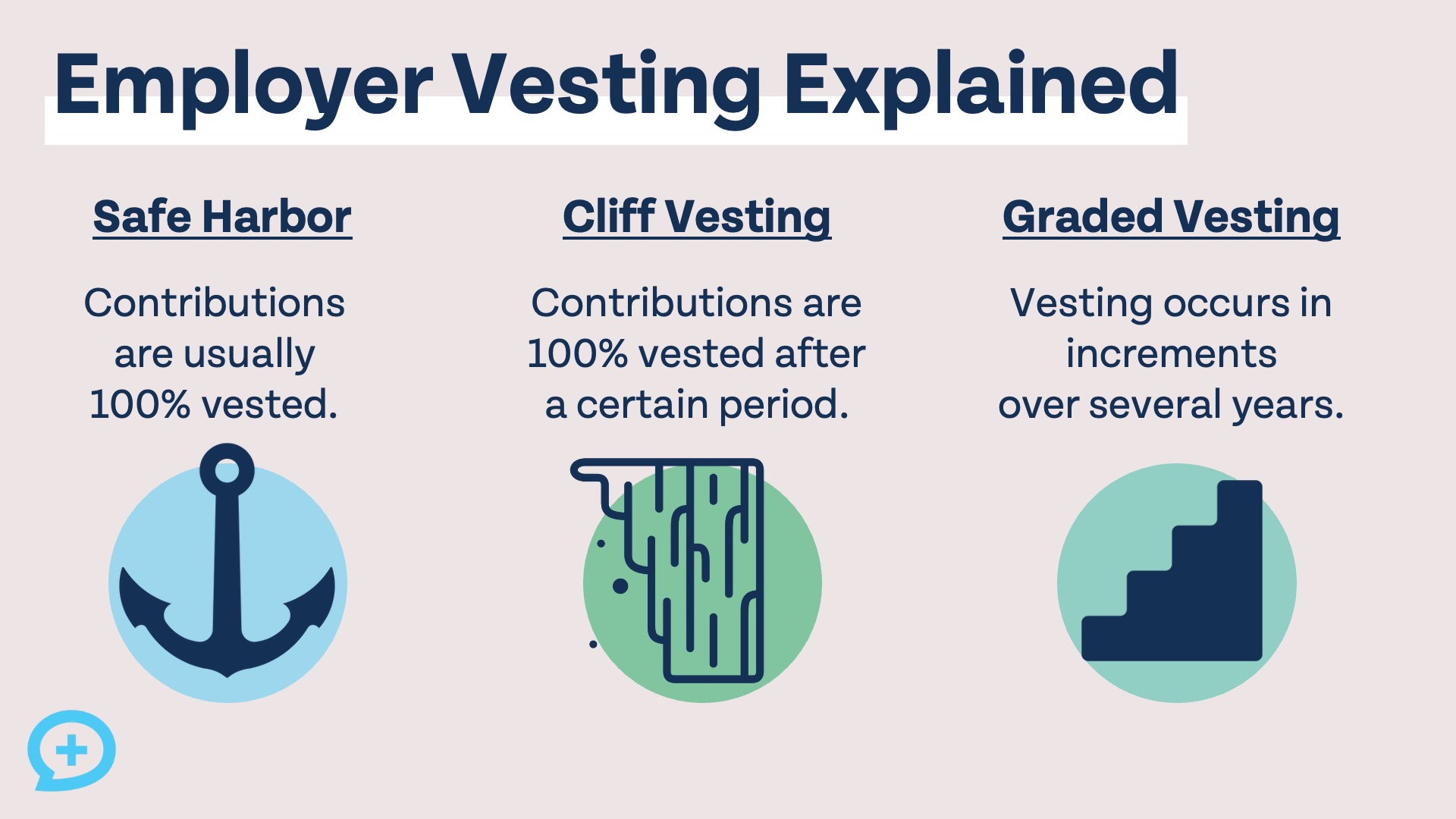
Every dollar you contribute to your 401(k) is yours to keep forever, no matter when you leave your employer. However, employer contributions could come with strings attached. Employer contributions often have vesting schedules, which means the funds are not actually yours until you have been employed for a certain length of time. Some employers offer immediate vesting, where everything is always yours to keep, others offer cliff vesting, where your employer contributions go from 0% to 100% vested after a certain period of time, and some offer graded vesting, where employer contributions gradually become more vested the longer you remain with the company.
Share image


Roth vs. traditional
Copy link to this section: Roth vs. traditional
Copied the URL to your clipboard!
Copy link to this section: Roth vs. traditional
Copied the URL to your clipboard!
Almost all 401(k) plans now have a Roth contribution option, which allows you to contribute after-tax money that grows entirely tax-free. Qualified withdrawals are also entirely tax-free. Pre-tax contributions, on the other hand, allow you to put in untaxed money that grows tax-deferred, but is taxed upon withdrawal.
Roth contributions provide a great future tax benefit, while pre-tax contributions give you that benefit now. So is it better to use the tax advantage now by contributing pre-tax dollars to your 401(k) or defer that benefit until the future? It depends on your combined marginal income tax rate. We think if this rate is above 30%, there is a good chance it will be lower in the future, and you will be better served saving money on taxes now.
If your combined rate is below 25%, there is a good chance it could be higher in the future, so contributing to your Roth 401(k) now and avoiding future taxes likely makes sense. If you are in the middle (25% to 30%), base your decision on whether or not you expect your tax rate to be higher or lower in the future.
Starting in 2026, making pre-tax catch-up contributions to your 401(k) may no longer be an option for many high-income earners. If you are 50 or older and your taxable earnings are $150,000 or more, any catch-up contributions must be made to a Roth 401(k).
Regardless of which makes sense for your situation, everyone that has the ability to do so should consider contributing to a Roth IRA, no matter your tax rate. Check out the video below if you have more questions about which type of account is right for you.
What to invest in + fees
Copy link to this section: What to invest in + fees
Copied the URL to your clipboard!
Copy link to this section: What to invest in + fees
Copied the URL to your clipboard!
Your 401(k) plan custodian is selected by your employer, and investment options are set by the custodian. A 401(k) typically only offers 8 to 12 investment options, so your choices may be limited and the options available may have high fees and expenses. If you are unhappy with the choices available in your 401(k), try talking with your boss or HR to see if they can make a change. If you work for a smaller employer, you may have better luck than if you work for a large employer.
Look for low-cost index funds in your 401(k), in particular target date index funds. Target date index funds are a “set it and forget it” investment option that automatically changes as you age. This means you don’t need to worry about adjusting your portfolio manually as you get closer to retirement. If target date index funds are not offered in your 401(k), consider other low-cost index funds if they are available. Some 401(k)s that don’t have great options may have neither available, in which case you’ll be looking for the best of the worst.
Learn everything you need to know about investing, including how to start, what to invest in, and when to prioritize paying off debt, at our Money Guy investing guide.
The fees and expenses 401(k) owners are responsible for vary wildly from plan-to-plan. Asset-weighted expense ratios of 401(k) plans, which weigh large plans more heavily, are just 0.36%. However, expense ratios for smaller 401(k) plans average around 1.60%. If you are in a smaller 401(k) plan with high expenses, don’t be afraid to advocate for change at your company. Your boss may not even know just how bad the plan is. Large custodians like Fidelity, Charles Schwab, and Vanguard may have better options for you and your employer.
401(k) withdrawals, loans, and taxes
Copy link to this section: 401(k) withdrawals, loans, and taxes
Copied the URL to your clipboard!
Copy link to this section: 401(k) withdrawals, loans, and taxes
Copied the URL to your clipboard!
When you take a qualified distribution or withdrawal from your 401(k), which means you are over 59.5, qualify for the rule of 55, or another exception, withdrawals are penalty-free and subject to tax based on the contribution type (Roth being tax-free and pre-tax being taxed at ordinary income tax rates). Required minimum distributions, or RMDs, start at age 73 for pre-tax 401(k)s, and increase to age 75 in 2033. You must take distributions from your pre-tax 401(k) when you reach RMD age, but Roth 401(k)s are exempt from RMDs as of 2024.
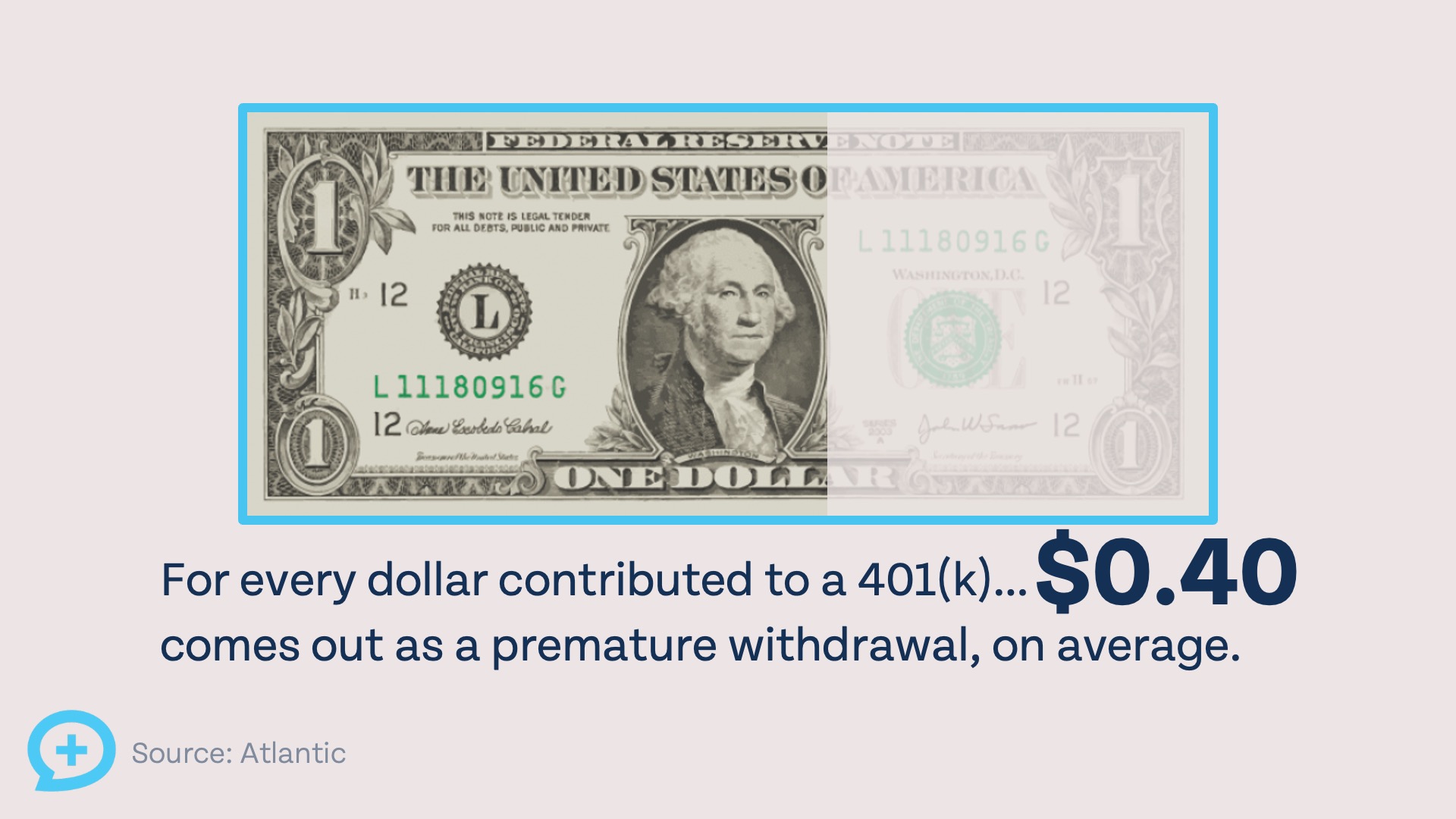
401(k) loans are generally available to active participants of a plan and may allow the employee to withdraw up to $50,000 or 50% of the account balance, whichever is less. Borrowing money from yourself instead of a bank may seem like an attractive idea, but taking a loan from your 401(k) can be damaging to your financial life. Loans must be paid back, with interest, and some plans do not allow participants to make new contributions with an active loan. Borrowing from yourself now could really negatively impact your retirement savings, not only by losing out on potential growth but by making it difficult or impossible to keep contributing normally.
Share image


While 401(k) accounts are tax-advantaged retirement savings vehicles, they are not tax-free, and in some cases taxes can be significant in retirement. If you contribute to your 401(k) on a pre-tax basis, which means your contributions are not taxed now but will be at the time of withdrawal, your account could become a ticking tax bomb the larger it gets. Many 401(k) participants choose to contribute to a Roth 401(k) or convert a pre-tax 401(k) to Roth to avoid this tax pickle. It does not always make sense to contribute to Roth, so consider your current tax rate and tax rate in retirement before deciding on the best course of action.
Rolling over a 401(k)
Copy link to this section: Rolling over a 401(k)
Copied the URL to your clipboard!
Copy link to this section: Rolling over a 401(k)
Copied the URL to your clipboard!
If you’re a Financial Mutant, one of the first things you’re looking forward to when starting a new job may be rolling over your old 401(k) to your new one…but should you really rollover your old 401(k)? Although it’s tempting to consolidate your accounts and have one less 401(k) to worry about, it may not make sense to roll it over. If your old 401(k) had better investment options, it could be worth leaving it alone, at least until you have a better option to roll it over to.
If you do want to roll over your old 401(k), it’s essential to ensure your last contribution has gone into the plan so you aren’t missing out on any money. If your employer offers profit-sharing contributions, closing your account before those go in, which can happen the following year, could cause you to lose out on employer contributions.
If your 401(k) balance is under $7,000 when you leave your employer, you may be forced to roll your balance over to another employer plan or IRA. If your balance is under $1,000, your employer is allowed to cash it out and send you a check. If your balance is over $7,000, here’s what options you have and when you should consider each.
| Option | When to consider it |
|---|---|
| Keep it there | Your old plan has low fees and great investment options. |
| Roll over to an IRA | Your old plan isn't great, and a pre-tax IRA balance won't get in the way of backdoor Roth IRA contributions (the pro-rata rule). |
| Roll over to your new employer's plan | Your new plan is better than your old one, with low fees and great investment options. |
| Cash it out | Generally a bad idea. You'll owe income tax on the withdrawal, plus a 10% penalty if you're under 59½ (unless an exception like the Rule of 55 applies). |
401(k) By Age
Copy link to this section: 401(k) By Age
Copied the URL to your clipboard!
Copy link to this section: 401(k) By Age
Copied the URL to your clipboard!
How do you stack up to Americans your age? Knowing exactly what other savers your age have in their 401(k) can help you determine how far ahead (or behind) you are when compared to your peers.
401(k) By Age | Early Career (20s)
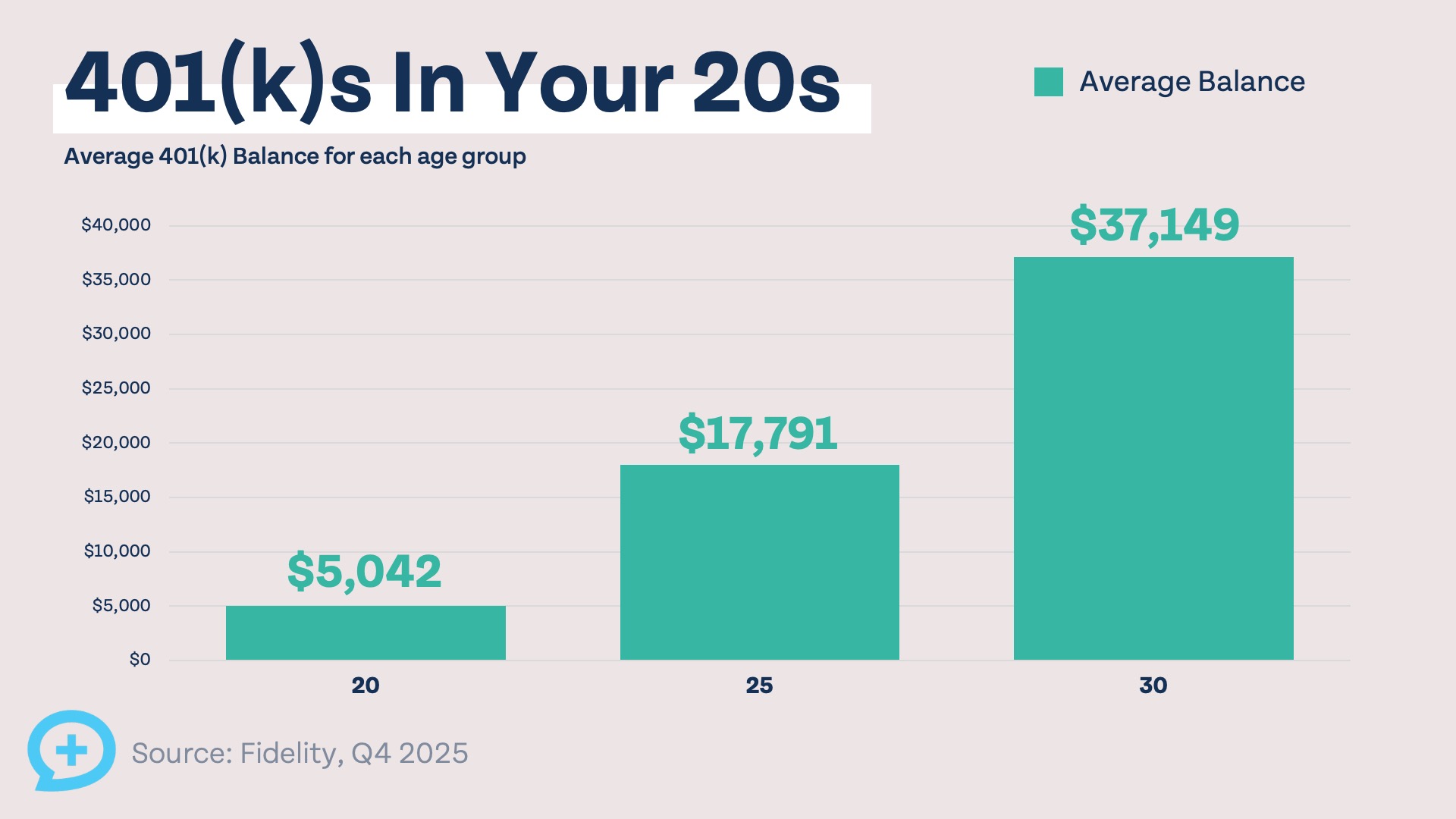
You may not be contributing much to your 401(k) in your 20s or right when you start your career – and that’s okay! Aim to get your full employer match after funding your highest deductible (Step One of the Financial Order of Operations). Start planning for your retirement now and take advantage of your employer match.
Share image


401(k) By Age | Messy Middle (30s)
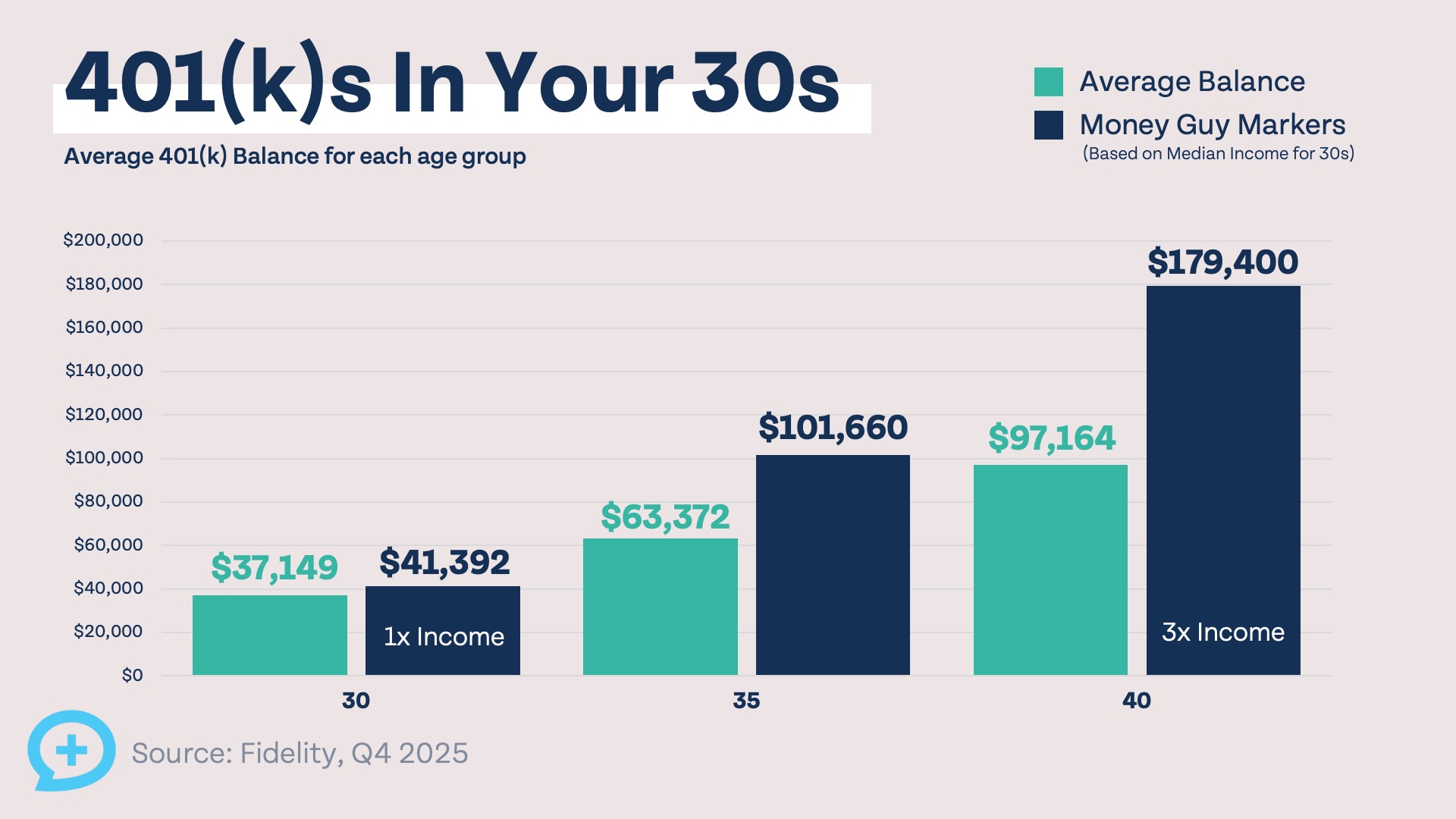
When you reach the Messy Middle, you need to have a plan so that every dollar gets maximized. Both time and money are scarce in your 30s. Aim to invest 25% of your gross income by the time you reach your 30s. You will also likely be contributing more than the match to your 401(k).
Share image


401(k) By Age | Mid-Career (40s)
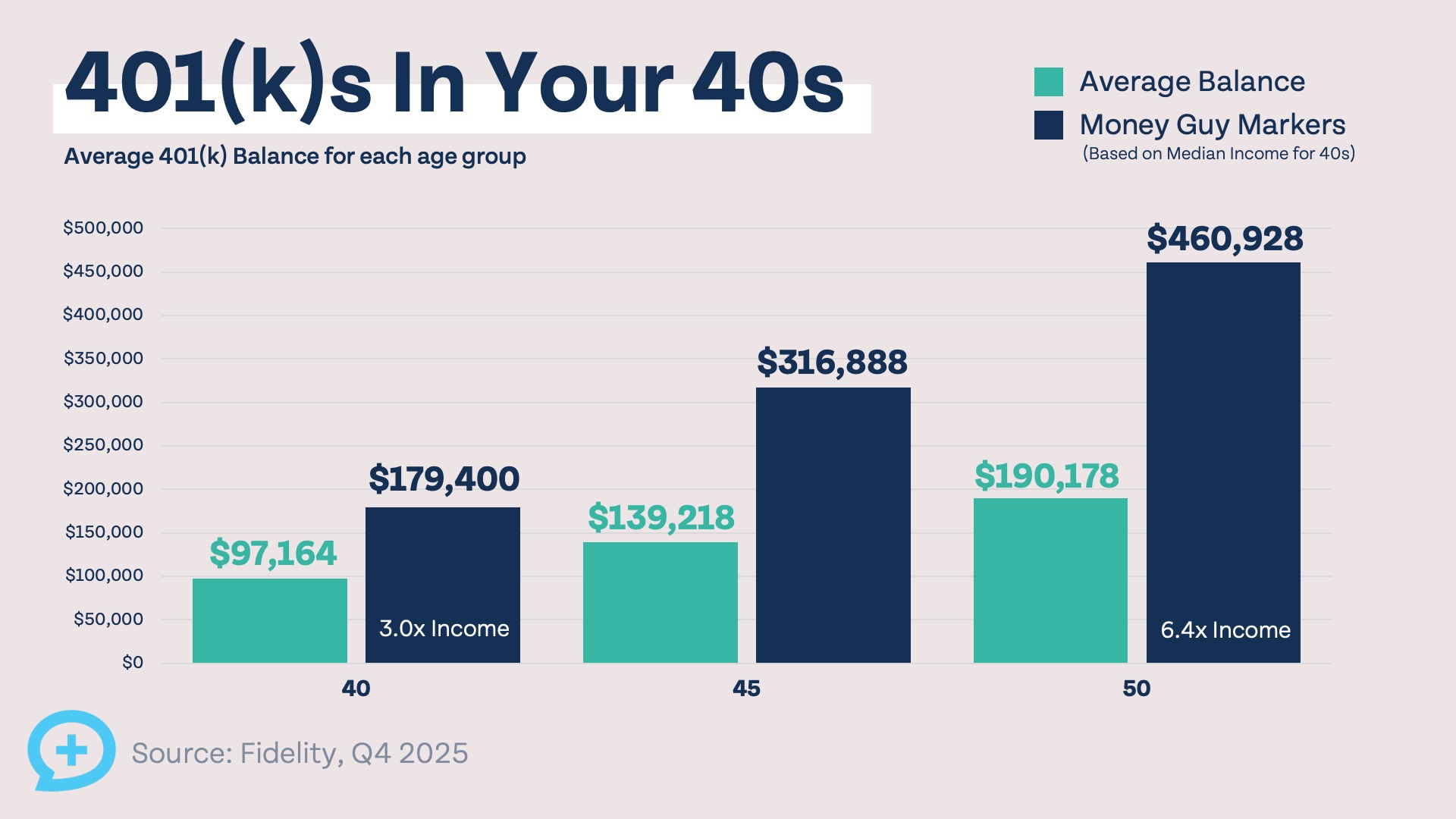
If you’ve been working for a couple decades in a job that offers a 401(k), your account is likely close to reaching a critical mass. If you are behind in retirement savings, there is still time to catch up. If you start investing from $0 at age 40, you can reach financial independence by age 69 by saving 25% of your income (assuming a 6% annual real rate of return and 80% income replacement ratio).
Share image


401(k) By Age | Nearing Retirement (50s & 60s)
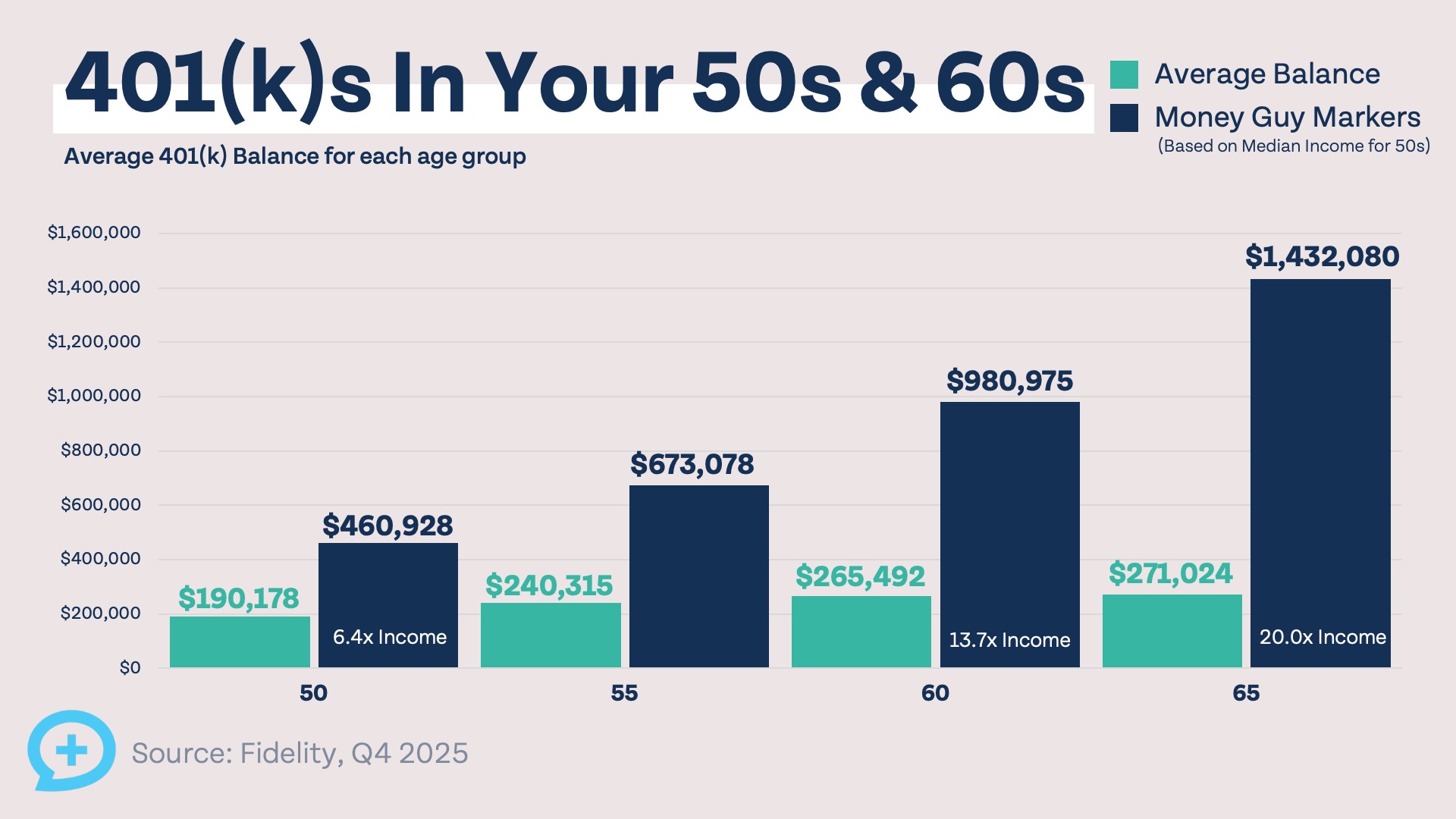
Crossing 50 is an exciting time to be contributing to a 401(k) – you finally get to make catch-up contributions! As you get closer to retirement, you should be dialing in your retirement plan and make sure you are doing what you need to with your retirement accounts. Do you have the ability to convert some money to Roth before retirement? How about contributing more right before retirement?
Share image


Glossary of 401(k) terms
Copy link to this section: Glossary of 401(k) terms
Copied the URL to your clipboard!
Copy link to this section: Glossary of 401(k) terms
Copied the URL to your clipboard!
Plan Administrator
The plan administrator is typically a third-party manager chosen by your employer to ensure the smooth operation of your plan. Plan administrators are usually not affiliated or associated with your company, but your company can change plan administrators if the service and options available to employees are not up to their standards.
After-tax contributions
Distinctly different from Roth contributions, employers that allow after-tax contributions may allow employees to contribute up to the annual additions limit and use what is commonly referred to as a mega backdoor Roth to build even more tax-advantaged retirement assets.
401(k) allocation
The allocation of your 401(k) is the mix of investments held in your account. If you like to keep things simple, you may only have a target date index fund, which is one investment that contains the diversity of an entire portfolio and automatically changes as you get older and closer to retirement.
401(k) beneficiary
Nobody likes to think about death, but naming the beneficiary on your 401(k) is extremely important. Whoever you name as beneficiary will receive your 401(k) assets if you pass away. Check your beneficiary whenever you go through major life changes and at set intervals, such as every year. If you are in a situation where you don’t update your beneficiary after, say, a divorce, your ex-spouse could end up with your 401(k) when you pass away.
Catch-up contribution
401(k) catch-up contributions are only allowed for those 50 and older and are intended to help those getting older save more for retirement and catch up if they are behind. Since the standard 401(k) limit is so high, not everyone will have the capacity to take advantage of catch-up contributions, but they can be a great boost for those with a high income who haven’t been saving for retirement like they should have.
Expense ratio
All funds have what are called an expense ratio, which is a percentage of assets that the fund charges as a fee each year. Very few funds have no expenses, as there are always some costs to operating investment funds, but many investment funds are very low-cost. Always consider cost when evaluating investment options, as a high expense ratio directly takes away from your potential rate of return in the investment.
Hardship withdrawal
Hardship withdrawals are available to participants experiencing financial hardship in limited circumstances. Unlike a 401(k) loan, these distributions are not expected to be repaid, but an individual can pay the funds back within 60 days to avoid penalties on the distribution.
Profit-sharing plan
Your employer may operate a profit-sharing plan within your 401(k) where company profits are shared with employees. There are rules and regulations that specify how much your employer must contribute and who receives a contribution.
Qualified distribution
A qualified distribution from a 401(k) plan is any normal distribution from the plan taken after the allowed age that does not incur penalty.
Top heavy 401(k) plan
A 401(k) plan may be deemed top heavy if key employees own 60% or more of the total assets in the plan. If a plan is found to be top heavy, the employer must contribute up to 3% of compensation to all non-key employees still employed on the last day of the plan year.
FAQs
Copy link to this section: FAQs
Copied the URL to your clipboard!
Copy link to this section: FAQs
Copied the URL to your clipboard!
How does 401(k) student loan matching work?
Employers can offer what’s called a 401(k) student loan match. If your employer offers this program, you can receive matching 401(k) contributions by making student loan payments, even if you are not contributing to the plan itself. This can be a great option for recent graduates with substantial student loan debt that may not otherwise be able to build 401(k) assets.
Will I be automatically enrolled in my 401(k) plan?
The law requires newer 401(k) plans, those established after December 29, 2022, to automatically enroll eligible employees. This means more employees will be automatically making contributions to their 401(k) plan, even if they never elected to make contributions. Of course, employees still have full control over their election and may choose to change their contribution amount or disenroll from the plan entirely.
How is my 401(k) different from an IRA?
401(k)s are similar to IRAs in many ways, but have many key differences: contribution limits are much higher for 401(k) plans, vesting is different (you always own all money you contribute to an IRA, but employer contributions to a 401(k) may vest over time), and of course personal IRAs don’t have any employer match. Here’s how 401(k) plans stack up to IRAs.
| Feature | 401(k) | IRA |
|---|---|---|
| Who offers it | Your employer | You open it yourself at a brokerage or bank (Fidelity, Vanguard, etc.) |
| 2026 contribution limit | $24,500, plus an $8,000 catch-up at 50+ (or an $11,250 super catch-up at ages 60–63) | $7,500, plus a $1,100 catch-up at 50+ |
| Contribution options | Every plan offers pre-tax contributions, and over 90% also offer Roth | Traditional (pre-tax) and/or Roth IRA, held as separate accounts. Roth IRAs have income limits. |
| Investment choices | Limited to the options in your employer's plan | Virtually unlimited, depending on the provider you choose |
| Early withdrawals | 10% penalty before age 59½ (exceptions include the Rule of 55 and disability) | 10% penalty before age 59½ (exceptions include a first home purchase, up to $10,000, and qualified education expenses) |
| Required minimum distributions (RMDs) | Start at 73 (75 if born in 1960 or later) for pre-tax money. Roth 401(k)s are exempt during your lifetime. | Same ages for traditional IRAs. Roth IRAs are exempt during your lifetime. |
Do millionaires invest in 401(k)s?
The data shows that 80% of millionaires invested in their company’s 401(k) plan.

Share image


Even if the vast majority of millionaires invest in 401(k)s, that doesn’t necessarily mean they are a great investment. If 80% of millionaires jumped off a bridge would you follow them?
Millionaires aren’t investing in 401(k)s for no reason. They are one of the best ways to legally hide money from the government. If you contribute to a pre-tax 401(k), your contributions are not taxed and your account grows entirely tax-free. If you contribute to a Roth 401(k), your contributions are taxed, but your account grows entirely tax-free and qualified distributions are entirely tax-free. The higher contribution limits of 401(k) plans make them one of the best ways to build tax-advantaged wealth. It’s no wonder why so many millionaires invest in them.
How much can my 401(k) grow?
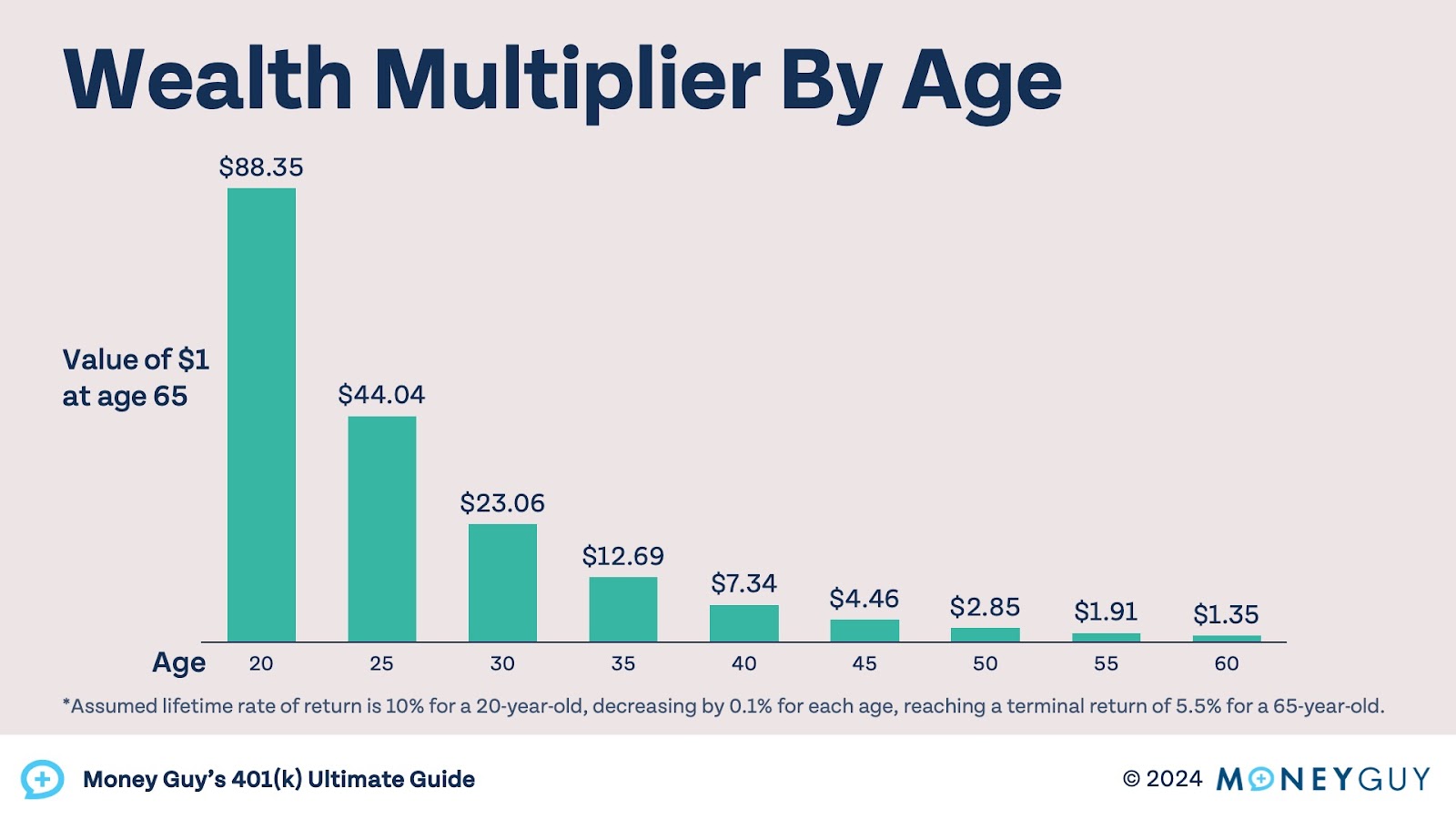
Every dollar you invest in your 401(k) while you’re working can grow substantially by the time you retire. The chart below shows what every single dollar you invest in your 401(k) could turn into by 65, using our assumed rates of return. At age 20, your Wealth Multiplier is 88.35. That means if you invest $1,000 in your 401(k), it could turn into $88,350 at age 65! If you are able to invest $10,000 at age 20, that amount could turn into $883,500 by age 65, assuming an annualized return of 10%. Use our interactive Wealth Multiplier tool to see what your dollars could turn into by age 65, based on your age and how much you currently have invested.
Share image


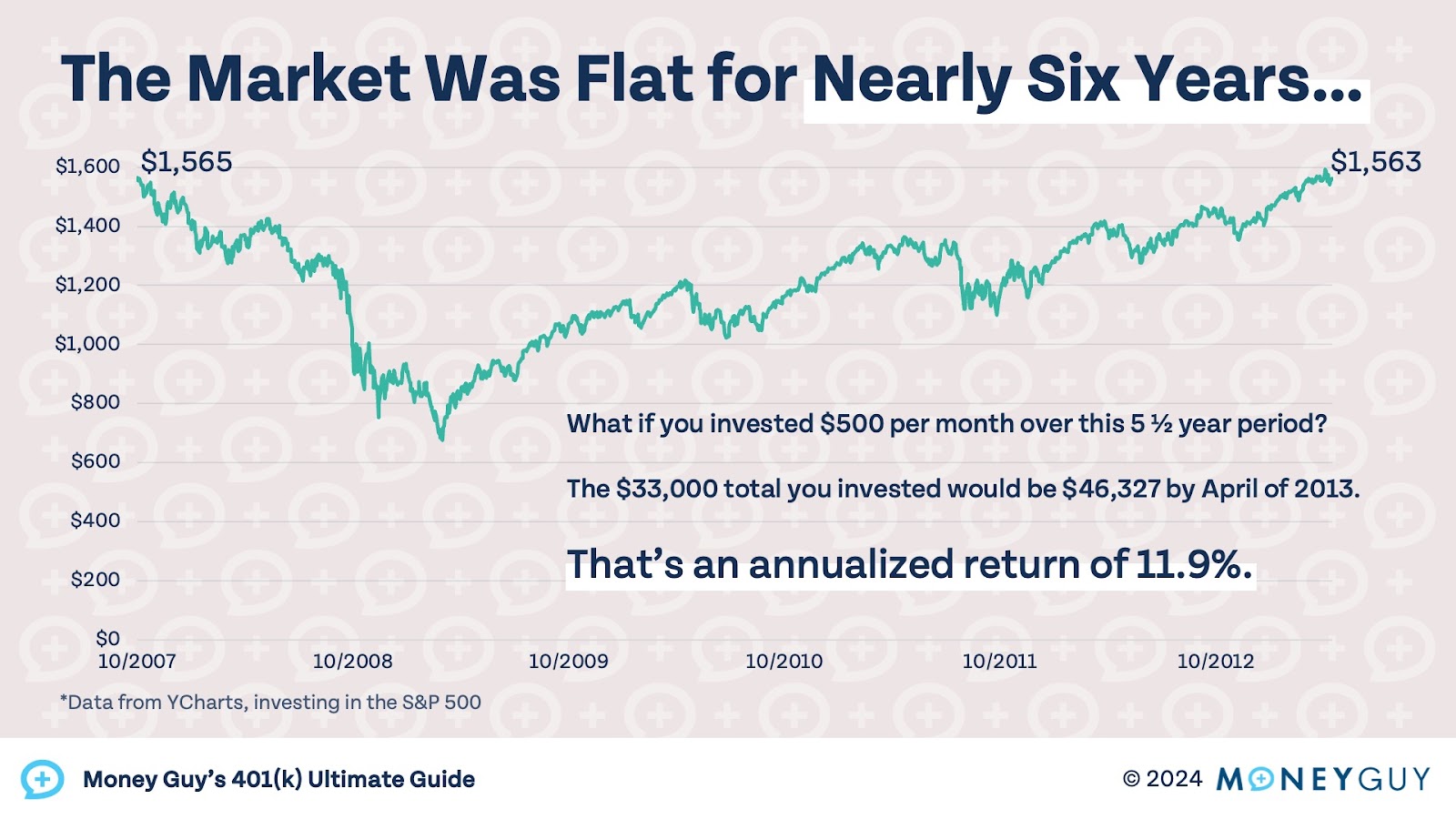
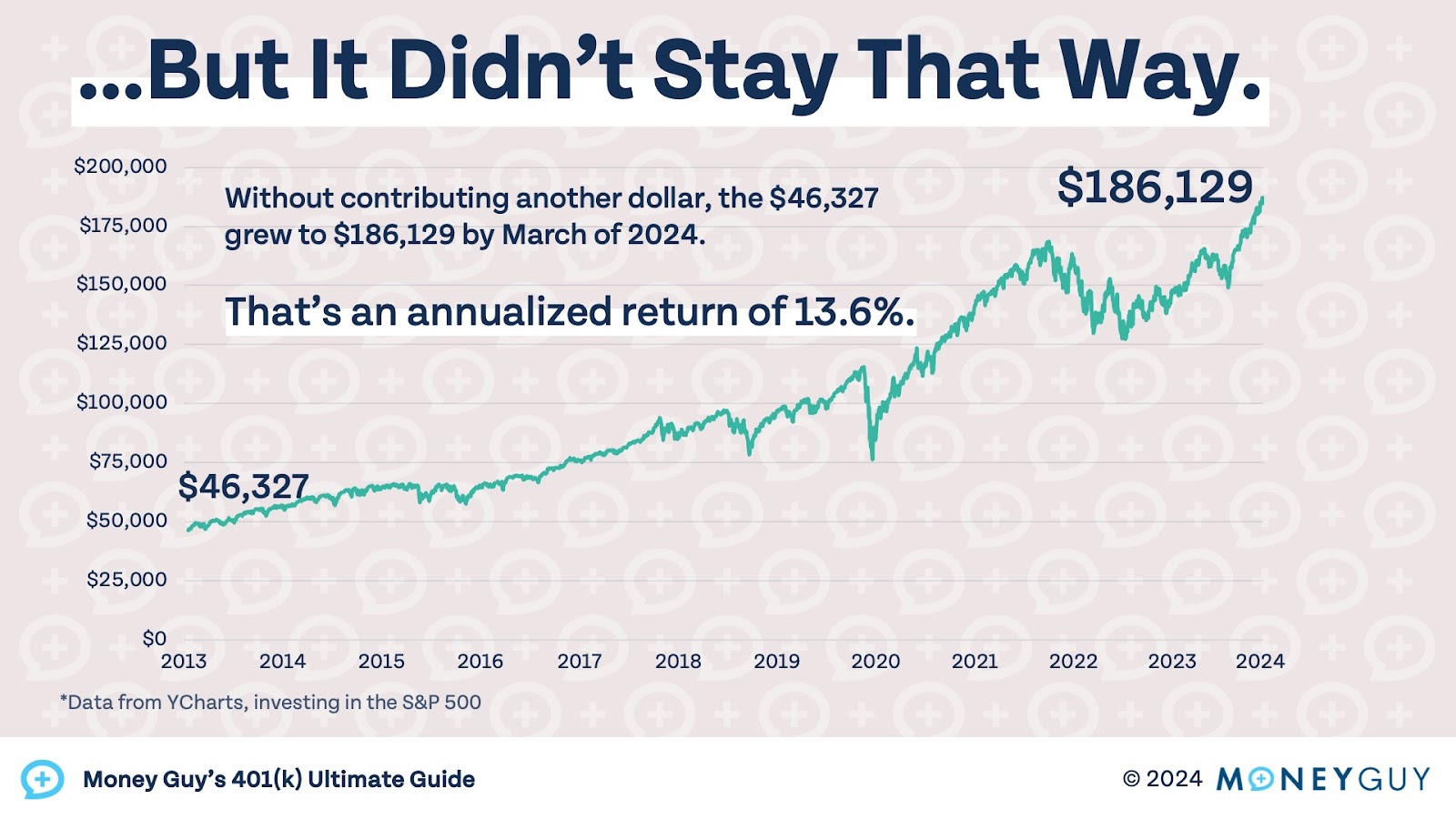
Our Wealth Multiplier assumes an annualized return of 10% per year, every single year. Over the last 50 years the S&P 500, an index tracking the 500 largest companies in the US, has annualized a little over 11%. But it’s not as simple as earning 10% or 11% every single year you invest. You can actually make money investing even during periods where the market is flat. Take a look at this case study using real-world data.
Share image


There will always be periods where the market is down or flat, and it may even last for years. Consistently investing over time, every single month, means you can make money investing even when the market is volatile.
Share image


How often should I make changes to my 401(k) strategy?
In some cases 401(k)s can be a “set it and forget it” retirement account, but you always should keep up-to-date with your account balance and any changes to your plan. Make sure your asset allocation properly reflects your financial goals and risk tolerance. If you are a young person with your first 401(k), it may not make sense to be allocated entirely to risk-off assets such as bonds. If you are about to retire, it probably isn’t a good idea to invest everything in small cap US stocks. Index target date retirement funds are a great option for hands-off participants that don’t want to manually choose investments in their 401(k).
Are there other resources to learn more about 401(k)s?
We have some great complementary resources to take what you’ve learned about 401(k)s to the next level. Check out our Know Your Number calculator to see if you’re on-track for retirement and how you may need to adjust your savings rate.
If you are in the military and wondering how the 401(k) stacks up to your TSP, check out our free guide to maximizing your financial benefits while in the military.
Watch our latest video breaking down the average 401(k) balance by age below.