Change your life by
managing your money better.
Subscribe to our free weekly newsletter by entering your email address below.
Subscribe to our free weekly newsletter by entering your email address below.


Your 401(k) is about to get a lot more complicated, and high earners just lost a major tax advantage. The IRS just released massive changes for 2026 that could reshape how Americans save for retirement, and not all of them are good news. We break down the new contribution limits: $24,500 in salary deferrals, $72,000 in total contributions, and expanded catch-up options for those over 50 and a special boost for ages 60-63. But here’s where it gets tricky: high earners making over $150,000 now face mandatory Roth catch-up contributions, eliminating the tax deduction flexibility many have relied on for years.
The bigger bombshell? Following an August 2025 executive order, alternative investments are entering 401(k) plans, potentially exposing $12 trillion in retirement assets to uncharted waters. We’re pausing on this one because more options don’t always mean better options, and according to the Financial Order of Operations, these assets belong in step eight for a reason. Whether you’re a high earner navigating the new Roth requirements or wondering if crypto belongs in your retirement account, this episode will equip you with the strategic insights to review your plan, understand your options, and ensure your investments align with your long-term goals. Explore comprehensive retirement planning resources at moneyguy.com/resources.
Subscribe on these platforms or wherever you listen to podcasts! Turn on notifications to keep up with our new content, including:



Bo: 2025 came with some sweeping changes to financial legislation and fiscal policy. With that came massive changes to your 401(k) and I am so excited to talk about them.
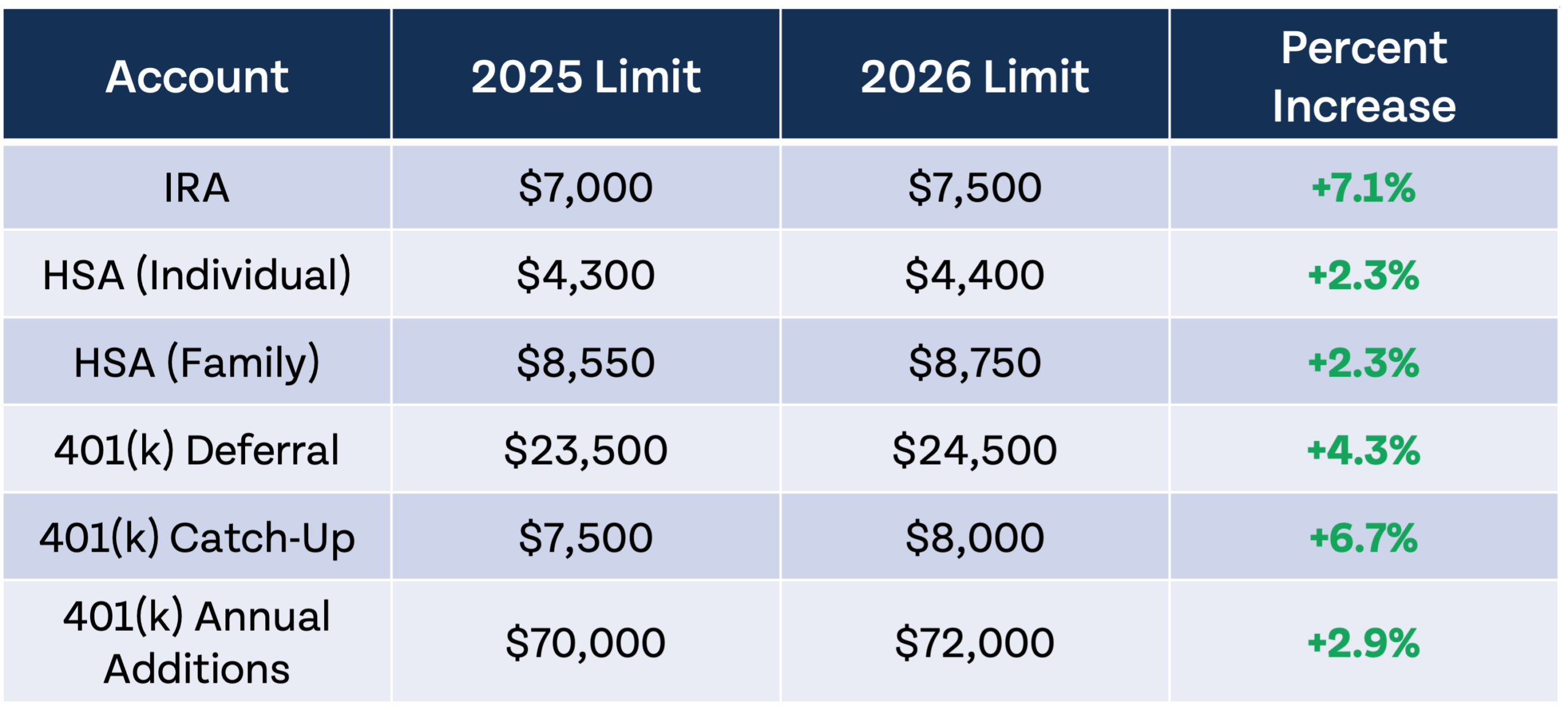
Bo: First, let’s cover some of the more basic changes that are affecting the most folks. The IRS has released the updated contribution limits for 2026. And for 401(k)s, the salary deferral limit is now $24,500. Not only that, but the combined annual contribution limit under section 415 has been increased to $72,000. This limit means that employer contributions and after-tax contributions combined can add an additional $47,500 to your retirement account.
Bo: A small caveat to these contribution limits is around catch-up contributions. Those over 50 can contribute an additional $8,000 per year. And those between the ages of 60 and 63 can contribute an extra $3,250 per year on top of that $8,000. And if that wasn’t complicated enough, the IRS has decided that for some, catch-up contributions must now be Roth contributions. Historically, contributors have been able to designate whether their catch-up should be pre-tax or Roth, but that’s going away. This change is specific to those that made an income of over $150,000 in FICA wages in the most recently completed year.
Bo: Let’s walk through a quick example to show you how this could impact your tax situation. Let’s say we have an investor age 55 making $200,000 a year in 2025. They’re able to make the full $23,500 traditional contribution plus a full $7,500 traditional catch-up contribution. Because traditional contributions give you a tax deduction on the front end, these contributions reduce the investor’s taxable income to $169,000. In 2026, however, while you can still make the full $24,500 contribution on the traditional side, that $8,000 in catch-up contributions must now be Roth. That means that the investor’s taxable income has only decreased to about $175,500. So, not only are they paying taxes on the Roth contributions, it’s possible that this could impact their effective tax rate as well. If you’re in this situation or if you’re close to it, make sure you check with your plan administrator about any changes. Make sure you update your payroll contributions as necessary and make sure you update your tax planning to account for these changes. And always remember to revisit your long-term goals to make sure that your timelines are still aligned.
Bo: There’s a much bigger change coming to 401(k)s very soon, and this one could likely affect everybody. In August of last year, an executive order was issued directing the Department of Labor to expand the scope of the types of investments that can be offered inside 401(k) plans. These investments are characterized as alternative assets, which include private equity, crypto, and real estate, among a few other types of financial products. As a result of this directive, the DOL rescinded prior guidance discouraging 401(k) plan managers from offering these types of investments. This was released back in August and the order gave the DOL six months to fully implement the change. This happens to be right around the time this video is coming out, which means that the DOL is nearing or maybe has already amended the existing rules around alternative investments and removed the restrictions that were previously in place.
Bo: What this means is that over the next few months, it is possible that these alternative investments will start to show up in 401(k)s. However, this is still something that the managers of 401(k) plans have to sign off on and implement themselves. Just because these options have been added does not necessarily mean that they’re going to be present in every 401(k) plan. It’s also likely that it will take some time to implement. Although the DOL has rescinded their guidance and updated their direction, these are still uncharted waters. Assets in 401(k)s represent 20% of the overall market or about $12 trillion. This isn’t something that plan managers are going to take lightly.
Bo: But I have to be honest, as a whole, I’m not sure that I’m super excited about this change. While more options sounds good in theory for folks that are building wealth, more doesn’t always mean better. These alternative assets like crypto and real estate are investments that we would generally say if you’re going to do them, you want to make sure you’re doing them at the right time. If we look at the Financial Order of Operations, which is our nine-step guide to building wealth efficiently, much of your investing is going to come about through steps two, five, and six. Those all pertain to various types of retirement accounts. In these steps, we emphasize the importance of broad market index funds. We categorize things like real estate investment and crypto as more of a step eight venture. Step eight is for when you’ve got your financial future secured and now you’re beginning to dabble in some of those other interests.
Bo: It’s not as simple as us just saying, “Okay, avoid these investments until you’re at the right stage” because we have to look at how these options are expected to show up because folks could miss this change if they’re not careful. Alternative investments are not expected to show up as standalone options in 401(k) plans. According to a 2025 study from T. Rowe Price, what’s expected to happen is that they’re likely going to be added to some target date retirement funds as part of their blend of investments. Meaning some investors may find themselves with exposure to these investments, even if it’s not directly and even if they don’t realize it.
Bo: This does not mean though that investors will be forced into these options, or at least it seems like that’s unlikely. Plan managers broadly anticipate that private market investment products will be offered alongside or next to public market options. This means these investments aren’t going to replace your existing funds. So those that don’t want these types of investments likely won’t have to participate. The key exception would be if plan managers opt to offer only funds that include private market investments. Given that over 80% of participants said they weren’t likely to choose these options, plan managers also seem unlikely to make that change. Overall, this means that existing participants won’t need to do much, but new participants will need to make sure that they’re selecting the correct funds when setting up their 401(k). Regardless of whether or not these alternative investments are something you’re considering, it’s a great opportunity and a reminder to check in every now and again to review to make sure your plan and your investments align with your unique needs, your unique risks, and your unique goals.
Bo: How do you make the most of your 401(k) in 2026? Whether it’s Roth catch-ups, private equity, or crypto, it’s imperative that you take an active role in your 401(k). 401(k)s and other employer sponsored retirement plans are many folks’s most powerful investment vehicles. They offer some of the highest contribution limits. They often include matches or profit sharing incentives, and they’re available to a huge sector of the workforce. 70% of the private sector currently has access to one of these types of plans. Not to mention, these are often most investors’ first account to cross into seven figure territory. In fact, in 2025, a record 654,000 Americans were listed as 401(k) millionaires.
Bo: And yet, most people neglect it. In 2025, roughly 1/3 of Americans cashed out their 401(k) after leaving a job. A little more than a third don’t get their full employer match, and a whopping 46% of Americans have no clue what their investment options are. Regardless of whether you’re dialed into your 401(k) or if you’re flying blind, use today as an opportunity to sit down, look at your plan, review your options, and create a plan that sets your future self up for success.
Bo: If you’re starting your wealth building journey, but you don’t know exactly where to start, click right here. And as always, keep building towards your great big beautiful tomorrow.


How about more sense and more money?
Check for blindspots and shift into the financial fast-lane. Join a community of like minded Financial Mutants as we accelerate our wealth building process and have fun while doing it.

It's like finding some change in the couch cushions.
Watch or listen every week to learn and apply financial strategies to grow your wealth and live your best life.
Subscribe to our free weekly newsletter by entering your email address below.