
-
▼


-
▼


Choosing a financial advisor is one of the biggest financial decisions you will ever make, but do you actually need one? In this episode, we pull back the curtain on the financial advisor industry, sharing the uncomfortable truth that not all advisors are created equal. From the difference between commission-based salespeople to the three distinct roles a good advisor can play in your life, we break down details most people never get before signing on the dotted line.
We also tackle the fee debate head-on, including why the common “1% cost you millions” argument on social media is a math crime, how advisor value is actually measured, and why 47% of an advisor’s real value comes from behavioral coaching rather than investment picks. Whether you are a do-it-yourselfer who just needs a second set of eyes, someone approaching retirement with a complex financial picture, or still in the early stages of building wealth, we walk you through exactly when professional advice makes sense and what to look for when hiring one.
Use the free 8 Questions to Ask Your Financial Advisor resource to make sure you find the right fit, and when you are ready to take the relationship to the next level, become a client and let Abound Wealth help you navigate what comes next.
Enjoy the Show?
Where You Can Watch and Listen:
Subscribe on these platforms or wherever you listen to podcasts! Turn on notifications to keep up with our new content, including:
- Episodes of The Money Guy Show every Friday
- Episodes of Making a Millionaire every other Monday
- Mini-shows every Wednesday
- Ask Money Guy Livestreams every Tuesday
- Tons of other fun content!



The Uncomfortable Truth About Financial Advisors (0:00)
Bo: Here’s a question. Are financial advisors worth it? And do you really need one? You might be surprised by our answer.
Brian: Brian, I am so excited because today we are addressing the uncomfortable truth about financial advisors, including an honest look at fees and how paying for an adviser actually affects your portfolio.
Bo: I’m Brian. He’s Bo. And we’re two financial advisers revealing the uncomfortable truth about ourselves. And with that, let’s dive in.
Truth #1: Not All Financial Advisors Are Holistic Planners (0:30)
Bo: Yeah, Brian. I think financial advisors get a bad rap and some of it is warranted and some of it’s not warranted. So, today we want to peel back the curtain and we’re going to talk about the uncomfortable truths about financial advisors and their profession. And I think uncomfortable truth number one is not going to be incredibly surprising if you’ve been out there in the financial world at all, but some advisors are really just salespeople.
Brian: Yeah. I think when people find out we’re financial advisers, I’m almost embarrassed to tell people I’m a financial adviser because the reality is anybody can call themselves a financial adviser and then you find out most of them are selling some type of product or good like life insurance or they maybe only know about this mutual fund family. So there are all kinds of things you need to be looking out for.
Bo: So when we use the expression financial advisor, we’re going to talk about holistic financial advisors. And if you’re someone who falls into that camp of being a holistic adviser, there are a number of different areas you’re likely going to cover. Those are like tax planning, insurance planning, investment planning, behavioral coaching, retirement planning, estate planning, and cash flow planning. It’s not one single isolated thing. It’s really taking a look at the client’s entire financial picture and helping them figure out how do all the pieces fit together.
Brian: Yeah. When we talk about holistic, because each one of these, if you’re watching this versus listening to it, you see we have a whole list of things. I feel like it’s almost like the R.E.M. song, it’s the end of the world and we have to start naming these things out. But in all seriousness, your financial advisor should be able to get in the weeds. Like if we’re talking about tax planning, how does the asset location impact things? How does tax-loss harvesting allow you to turn lemons into lemonade? There are all kinds of things that go into this. Even when you get into estate planning, how do we make sure that not only are you passing the assets well, but we make sure that the kids are going to be good with the money when it actually comes their way? These are things that a holistic planner can do for you.
Brian: So, if that’s what a holistic planner is, let’s talk for a moment about what a holistic planner is not. And do not mishear us. We’re not saying that these types of individuals are bad people or that they’re bad professions. We’re just simply stating these are not holistic advisers. The folks that would not be holistic advisers are folks that are focused solely and exclusively on asset management. All they’re doing is investing or all they’re doing is money managing. That’s not a holistic adviser. Insurance agents are another great example. If someone is only selling insurance products, whether that be life, health, disability, or even property casualty, they’re likely not a holistic financial advisor.
And then there are financial coaches. Now look, this is a new trend that’s kind of popped up. A lot of people, when you find out that you have an aptitude and you love personal finance, you’re like, “Well, hey, I can get into this.” Our whole thing is there’s nothing wrong with it, and you’ll hear in a minute how we talk about how financial behavior is definitely a key part of what you want your financial advisor to do, but there are huge limitations we see when we find the whole category of financial coaches. So you may need in your world potentially an asset manager or an insurance agent or a banker or some sort of financial coach, but that’s very different than a holistic adviser. Someone who’s taking a look at your entire financial picture and helping you put all the pieces together. So that’s uncomfortable truth number one.
Truth #2: Different Clients Need Different Advisors (3:51)
Bo: Brian, uncomfortable truth number two is, I think, going to be a little surprising. When it comes to clients, not every client gets treated the same when it comes to financial advice.
Brian: Well, I mean, there’s a huge difference between somebody who’s at the beginning of their journey, say you have your first $100,000, versus somebody who’s at $10 million. They have different needs. But also, and I think this is not a negative, because you’re going to hear in a minute that we think there’s actually a time and a place where there are moments in your life where you just need somebody to tell you, “Hey, what’s the answer so I can get past this problem and then keep living my best life?”
Bo: Yeah. And so if you have an adviser, depending on your circumstance and what you need from the adviser, they may serve a unique and distinct role. One of the roles that an adviser might serve would be something similar to like a mechanic. Someone who sees what’s going on in your life and understands the process and the things necessary to fix it. This is where you can think about, from a financial standpoint, these are where your functional needs are met.
Brian: Yeah, this. Look, from a peace of mind standpoint, if you had a one-off thing come your way, this is going to help if you have any anxiety about it. You just don’t know what you don’t know and have a blind spot about it. It makes sense to find somebody who might be an expert on this one specific thing.
Bo: Yeah, maybe it’s someone who’s retiring and you’re trying to figure out how do I simplify my account structure for required minimum distributions, or maybe you have an inheritance coming in and you have specific questions around how to navigate that. When a financial adviser is serving solely as a mechanic, this may be for a unique circumstance or potentially even for a one-time, one-off situation. So, we like the mechanic role, it can serve that purpose. But you might want to move to the next category of needs, the doctor. This is somebody who understands more of your full picture and can monitor changes and also foster that you feel good about where you are financially.
Brian: Yeah. If you think about a medical professional, oftentimes what they’re able to do is catch problems before they actually become a problem. They’re able to be more forward-thinking, like focusing on estate planning or wealth transfer. Not only can they diagnose and assess where you are today, but they can also help paint a picture and a path for where you ought to be in the future. And they can work with specialists. Just like we always say health is wealth, but there are so many correlations between where you are with your health as well as what you’re building in wealth. And so I like pointing out that just like when you go to a doctor you might need a cardiologist if you’re trying to focus on your heart, or you might need a physical therapist if you have something that you need to rehab, well, we’re the same way. Think about when you’re working with attorneys to help you with the estate plan or maybe every year when you do your tax prep for compliance, you work with your CPA. Wouldn’t it be nice if you had somebody who could sit between there and kind of communicate, talk their language, but help you in a holistic way do the best thing with your financial life? Just like you would if you were navigating whether it was cancer or a heart issue or a rehab issue, it would be nice if your primary care physician could help navigate all this and serve in the quarterback role.
Bo: And so a lot of those two roles, whether it be the mechanic role or whether it be the doctor role, are sort of IQ-focused. But there is another role that a financial advisor can satisfy. And this oftentimes is more EQ. And this is the personal trainer role.
Brian: Oh, this is a huge one. Just like when it comes to fitness, just like when it comes to working out, sometimes you need someone to help you know the things that you don’t know. And actually once they educate you on the things you need to know, help keep you motivated to stay the course and make the good decisions easy and the bad decisions hard. Look, this is one I don’t mind bringing up because it’s back to the correlations of health and wealth. We all need a good coach. And if you’ve ever, I don’t like working out. Bo does like to work out. But you can know that sometimes you need a good trainer to kind of enforce the good behaviors because if I had to go to the gym and just do it by myself, I’m probably just doing the beach muscles. You know, I’m going to do some bicep curls, I’m going to do a little bench press and call that a great workout. No. When you go to a personal trainer, they’re going to actually make you not skip leg days and do all the work. And also protect you from anything that you don’t want to do. The finances are the exact same way. You think about when the stock market’s getting its teeth kicked in, maybe you have a risk or a scare that you’re losing your job. It’s good to have somebody help you navigate both the negative and the positive behaviors or life events that are coming. That’s where a good financial adviser is going to be able to navigate that. Just like a good personal trainer will help you do that in your exercise.
Bo: Well, and they can keep you accountable. They can say the things to you like, “Oh hey, you’re not saving enough. You need to change this.” Or on the flip side, hey, now you can start spending more. You get to actually enjoy the fruits of your labor. And so Brian, when I think about how we get to work with our clients and serve them, what’s interesting is we kind of move in and out of these roles. And sometimes we are the mechanic and other times we’re the personal trainer and then even other times we’re the doctor. And so when it comes to a financial adviser, depending on who the adviser is and where you are in your financial journey, the way that they treat you and the way that you interact with them might be very different. It’s not going to be the same cookie-cutter solution as every other client. And we would argue that’s actually a good thing.
Brian: Yeah, I think it comes into, because even back to that accountability point, you think about sometimes like estate planning. Spouses will have different opinions about something and so the work never gets done. What I always find funny is that when you know you have a client appointment scheduled, how they all procrastinate, but then at the last minute they start pushing to get that done. And it’s the accountability that makes it happen. That’s why I love bringing it all together. Whether it’s the mechanic who just has a one-off where you’re just trying to get through the solution, help me with the logistics of it, the doctor who knows the whole situation and can talk to your accountant and can talk to your estate planner, or the personal trainer who’s going to hold you accountable to make you the best version of yourself. All these things are interconnected.
Truth #3: Investing Isn’t Where Advisors Add the Most Value (9:54)
Bo: And what’s interesting as you think about how they serve different roles and they have distinct responsibilities, it kind of leads into uncomfortable truth number three, which I think is a common misnomer out there in the public: when it comes to financial advisors, picking your investments is usually not going to be the main value that they provide. This is one, whenever I meet anybody and they don’t really know what I do for a living, when they hear financial advisor, they ask me for stock picks. And I hate to break their heart and always tell them, hey, instead of trying to beat the market, I’m just being the market. I like index funds, which are about as sexy as, well, I can’t even think of what I would fill in the blank with on that. But that’s where I think most people really are in a situation where they don’t understand what a good financial advisor will do for you. It’s more about the planning than it is trying to pick the next investment. In a lot of ways, investments have been commoditized because of index funds. If you go look at the SPIVA data and other things out there, investing in general has been commoditized. You better be getting more value than just asset allocation.
Bo: That’s right. A really good advisor should be able to help you with taxes, estate planning, retirement planning, risk management, cash flow, college planning, home buying, refinancing, fill in the blank of any financial thing that might come across your desk. They ought to be able to help. So the question becomes, if a financial advisor is doing all these things and it’s not specifically investment-related, how do I quantify value? How do I assign some value to what it is an adviser does? Well, the Russell company actually does an analysis of this every year through their Advisor Value study. And in 2026, they actually found out that the potential value of an advisor in the US is estimated to be 4.92% annually of additional value add to a client’s situation and circumstance.
Brian: So, when I first heard about this, I was like, wait a minute. So close to 5%, where is this value being added? I love that they actually stratify this and I think it’s important for us to go over because it makes the point that I was making earlier. If you think that your investment adviser is only going to be adding value through investments, because that’s all over social media, you hear people saying, “Why would you hire a financial adviser when you just buy an index fund?” Or you see that meme where the guy’s stopping the subway and then he walks away and then pushes it away and it got gazillions of engagements on it because people love trashing financial advisors. And I’m like, guys, that’s not where we add value. You think that it’s only in the investments. And look at this, when you look at the value of an advisor, what’s the smallest subsection here? It’s asset allocation. It’s only 5% of that extra gamma that you’re expecting from a financial advisor. If you look at what the biggest thing is, it’s all about the behavioral coaching. If you think about how many people get trapped in this trap of fear and greed, meaning that when markets are getting their teeth kicked in they’re scared to death, and when markets are at all-time highs they say, “Let’s go get some more of that.” This is the thing I deal with on a day-to-day basis. And by the way, it gets really amped up when you are in the two comma club. When your assets are in the millionaire and beyond status, you start panicking about what you don’t know. So 47% of the advisor value add is through behavioral coaching. Another 23% through customized family wealth planning and another 25% just through taking into account taxes and tax-smart investing and planning. So an adviser can add the tangible value which Russell was able to quantify in a dollar figure, but there’s also some non-tangible value that an adviser adds on the psychological side. In fact, 93% of people that are looking for an adviser or have an adviser currently said that the reason they want an advisor is that they would like additional peace of mind when it comes to their financial circumstances.
Bo: This is what I love about what we do. Just like one of my favorite books when I first discovered the wonderful world of personal finance was Millionaire Next Door. And I love that somebody has actually taken the time to go out there and interview millionaires, find out what they know about money that the rest of the public doesn’t know. You can imagine as we’ve started working with thousands of wealthy families, we were like, “Hey, maybe we could also start shedding a light on what millionaires think about things by doing annual surveys of our clients.” We also survey our Financial Mutants in our audience as well. But what it really highlights with our clients, and this is very fulfilling, is we asked that question. We said, “Hey, if peace of mind is the goal, are you more confident with your financial decision-making now that you have an adviser?” And look at this. 81% of our millionaire clients say they are not stressed about money anymore. Now compare and contrast that to the general public. Capital One and the Decision Lab asked Americans, “What do you feel about money?” And 77% say that they feel anxious about their current financial situation. Guys, that is a stark compare and contrast on what the difference is between these two groups of people. So there are obviously quantifiable things that a financial adviser can help you with, but there are also qualitative things that a financial adviser can help you with.
Truth #4: Financial Advisor Fees Explained (15:35)
Bo: And so you think, all right, there’s value that can be added. There’s value that can be assessed, but financial advisors don’t do this for free. There are often costs associated with this. So that leads to uncomfortable truth number four: when it comes to a financial adviser, the fee structure and what you’re paying matters.
Brian: People who are watching this are like, finally, they got to the fees. Let’s talk about the fees. Are these guys ever going to share? Yeah, let’s have a conversation about this. The first tier is commission. Now look, when I first got in the industry, I’ve been doing this since the 90s. This is where the majority of people were, and it’s still where a lot of people are. It’s still a little gray, but it’s starting to get a little more clarity now that we’ve gotten into fiduciary rules and so forth. But when you’re talking strictly about, hey, I’m going to sell you a product and I’m going to make money off of that, that’s the commission. That’s your life insurance agents. That’s what I call the grocery store financial advisors who are in the strip shopping center selling you goods. These are things that are pretty in your face: you go and you’re not really buying the advice, you’re more buying a product and they’re getting paid a commission.
Bo: Yeah. The way that they get paid is not actually from you, but from some third-party company encouraging them to sell their products. That’s the commission base. Well, then there’s the fee-based side where perhaps commission is still part of it, but there’s another fee. There’s more of a flat fee or retainer fee or an asset-based fee that goes along with it. And it’s kind of like dipping your toes in both worlds. I have some fee-based business, but then I also have some commission-based business. They kind of blur the line between where the distinction is. And then the last is the elusive fee-only fiduciary adviser. This is the one where legally the financial adviser is required to put your interest ahead of even their own. If they don’t, you can legally sue them.
Brian: Yeah. And surprisingly right now the fee-only advisor space makes up around 4.92%, so less than 5% of the entire financial industry. Now, truth be told, it has increased. In 2018 it was only 2% of the industry. So it’s doubled, but it’s still a relatively small portion of the entire financial advisor space. But even inside the fee-only world there are different business models, different structures that you ought to be aware of. The first are advisors that work on an hourly basis, and it’s exactly what it sounds like. They bill based on the hours they spend working on your financial plan. And oftentimes those billable rates can be somewhere around $200 to $400 an hour.
Bo: Yeah. What’s really beneficial about this is it is a lower cost. If you’ve got a problem, remember how we were talking about the mechanic role. If you’ve got a problem, you’ve got a one-time thing that you need somebody to look at, this is a great opportunity. The cons: it is more transactional. Every time that you call the adviser, there’s going to be an invoice or cost, and that creates some form of friction.
Brian: There’s also a loss of the shepherding process or the logistics. Like if you need to transfer assets or implement a plan, you’re more likely for it not to happen if you’re the one that’s responsible and there’s nobody shepherding you through the process. And then let’s not forget it’s difficult to scale because you’re limited, all of us as individuals are limited by the number of hours that we can work. So that also impacts the financial advisors operating this way.
Comparing Hourly, Flat-Fee, and AUM Advisors (18:51)
Bo: So where the hourly model has some shortcomings, enter the retainer or the flat fee model. And this is a little bit different. Rather than tracking the hours that you’re spending, there’s an agreed upon scope of work and an agreed upon fee that that will cost. It can be one-time or in a lot of circumstances, it’s an ongoing flat fee. And usually this can be anywhere from $2,000 to $7,500 a year. But for more complicated engagements or larger scopes, it could even be up as much as tens of thousands of dollars a year.
Brian: Yeah. What I do like about this is it’s nice and it’s appealing to have fixed costs. And I also like that if you think about if you’re a younger person with a big income but you just haven’t had time to build up assets, and you don’t have assets to manage necessarily, it is nice that this is available to smaller asset sizes if you needed that type of advice. The only thing, and the con is, there is some friction in the fact that it’s less likely to be concierge service because they’ve put boundaries on how much of a scope that there’s a defined limit to. And there’s also the incentive of volume because if you have set where the limit is on the relationship, that means there’s a goal to take on more and more clients and there could come problems when it comes once again to scaling of that business model. And now there is a time and place where the flat fee structure does make a lot of sense. And if that’s specifically what you’re looking for, if that sounds like that might be a fit for where you are, keep listening because we actually do have a solution to share with you there.
Bo: And then there’s the third fee model, and this is one you hear us talk about a lot because this is what we do here at Abound Wealth Management, and it’s the assets under management fee model. And what that means is the way that the advisers are compensated is based on the size of the portfolio or the size of the assets that they are tangibly helping you manage.
Brian: Yeah. And you can imagine on the pros side, the aligned incentives, meaning the more money you make the more the adviser makes. If the account loses value, the fee also comes down. It is more likely to be more of the concierge services we talked about. It’s more of a premium product. So there’s no limits on the service necessarily. And then what we talk about with the decreasing effective fee: what that basically means is the bigger the account size, there is a bigger and bigger discount based upon the assets that you are having managed. ?
Bo: But there are downsides. One of the downsides of the assets under management model is that it does generally require a focus on higher net worth clients. In our world, we want to be able to build intimate, deep, ongoing relationships with our clients. The only way to be able to do that effectively is if you have some sort of minimum fee service or minimum level of client that you work with. And because of that, there tends to be a higher cost. Again, this is holistic planning. Not just looking at investments, but looking at the entire financial picture to bring it all together. So those are the three different fee-only models. That’s how much an advisor could cost. So now let’s see, okay, when you think about the fee, how does that ultimately affect you?
Does Paying 1% Actually Cost You Millions? (21:49)
Bo: Let’s break it down. Let’s use a common example that we see on social media all the time. Let’s assume that you have a do-it-yourself investor and this person has a portfolio of a million and a half dollars and they decide, hey, I’m not going to hire an adviser and I’m going to have a diversified portfolio, and over the long term I’m going to make an 8% rate of return. Well, if that do-it-yourself investor invests that million and a half dollars at 8% over a 25-year time period, they would have over $10 million by the time they get to the end of that 25 years. That is remarkable. Do-it-yourself investors have the potential, have the ability to do that. We said at the beginning, we don’t think that every single person needs to hire a financial adviser. Now, here’s where social media always goes wrong. They say, “Okay, but if this do-it-yourself investor would have hired an adviser, and that adviser would have charged a 1% fee, rather than this client ending up with $10.2 million, they would only have $8 million. That’s a 22% haircut on how much money they would have had.” Now, let’s pause there for a moment before we even talk about anything else. If that were your circumstance and that were your situation and on your own you could have $10 million, but then you hire an adviser and you’re only going to have $8 million, you should never do that. That doesn’t make any sense at all. And we would agree with that. But when it comes to this illustration, there’s something you ought to know.
Brian: Well, first of all, everybody should know that most people we work with, millionaires and beyond, they can vote with their feet and move their assets. They’re not idiots. These are really smart people. And every year they resign back up. There ought to be your first clue. But the other thing that really irks me about when people do this math is it’s a straight-up math crime because they assume, and I alluded to this earlier, is that if you’ve got a million dollars and you’ve now grown it to $10 million and they’re doing the math on their 1%, just assuming it’s a flat 1%, it’s probably because it’s easier to do that math and it creates this huge spread. But it’s back to my point: when you show up with more assets, just like when you go to Costco, it’s the same way with asset management. The more you show up with, the cheaper your fee is. Guys, you show up to a financial planner, a good holistic planner, and you tell them you’ve got $15 million, watch how good they can sharpen that pencil on their fees. And that’s the thing: it’s a math crime to assume that people are going to be paying 1%. There are break points, there are discounts, there are effectively lower fees the more money you have invested, and people kind of skip over that. It’s a little disingenuous, but it does always get skipped over. So for example, if you want to take Abound Wealth, this is our fee structure. We charge one and a quarter percent on the first million, 1% on the next 2 million, 75 basis points over the next 2 million, and then half a percent over 5 million. So the math crime number one is they didn’t factor in that our fee actually decreases effectively through time. But the bigger math crime, and I think this is the more egregious one, is if all you do is hire an adviser and all the adviser does is take 1% of what you would have otherwise made, then that’s not a favorable trade-off. All you’re doing is spending money and getting nothing in return. Because when you hire an adviser, you ought to get value for that service you’re paying for.
Bo: So we said, “All right, Russell did this analysis where they said that on average an adviser can add 4.9% annualized to the value of a client.” We said, “What if we just took half of that? Cut 4.9 in half so we have 2.46% and factor in the effective fee.” So in reality, the client with an advisor ought to be able to do better than they can do on their own through all of the different areas where an adviser adds value. In that scenario, after you factor in the effective fee, after you factor in the value add, this client over a 25-year time horizon would actually end up with over $14 million. That’s 39.5% higher than they would have ended up with on their own.
Brian: Yeah. You know, this is what I’ve, you have to be careful when you just look at raw stuff. And that’s what it is. It’s back to the question: what is the value that an adviser is doing? I love this because I’ve even had my own clients who’ve fallen prey to some of the stuff on social media. I had a client who’s been with us for 15 years and I literally feel like I have dragged this client into financial independence because he’s not a natural saver. He’s not very good at understanding deferred gratification. So every time we’ve had our meetings throughout the years I have really held him accountable and squeezed a little bit more out of him. But fast forward now, he’s a multi-millionaire, even though he never made huge incomes, and I’ve pulled him through for the last 15 years that he’s been a client. He’s like, “Man, I just watched something. I’m getting close to retirement. I see how expensive this fee is.” And I was like, “Pause.” I was like, “We’re about to reach where we’re going to be doing annual Medicare analysis. We’re going to be doing Roth conversions.” And I named off this whole list of all the things, plus the annual stress testing that we do. I was like, “You realize that we have grown this thing to a level of value now that you’re about to get even more value out of this. This is the worst time to leave.” And after I showed that, he’s like, “You know, I didn’t even think about that. I was just thinking about this analysis I saw where somebody said this is what you’re paying.” It’s also about what you’re actually receiving in the services. A lot of these people are smart people. They wouldn’t do this. And I tell you that because I’m unapologetic that this is how we get paid because just like your time is the thing that helps compound growth and helps you build wealth, it’s also your limitation. I am no longer a young man that I’m limitless on my time. We only can work with so many clients. And you’ll find, I think, when you interview people, we’ve been in some calls in the last week where you get in a room with attorneys, accountants, and others, you realize, oh my god, how many people can you help speak the language and make sure that this person’s not trying to nerd out and show how smart they are from ego? This person’s trying to show somebody’s got to be humble in this room and actually help the client understand what each of you are saying and then bring it all together. And that’s what I love we get to do. And I say this not from a place of defensiveness. Don’t mishear this. It’s more that I’m so passionate about what we do that it breaks my heart if you think that people can just charge fees and not add value and it’s going to end in a successful place. And that’s just not where it’s at.
When You Don’t Need a Financial Advisor (28:53)
Brian: And I think that’s probably a great segue, Bo, to our next uncomfortable truth, and this is what makes us unique. We don’t think everybody needs an adviser. Hence, back to the origin story of why the Money Guy Show even exists.
Bo: Yeah. If your life is relatively simple or you’re a do-it-yourselfer or you have a special affinity for this, it’s why we have all the free content out there. It’s why there are books and YouTube channels and courses and deliverables and the Financial Order of Operations. All of this is out there to help you do money better. There’s advice on how to pay off debt. There’s advice on how to save for college. There’s advice on how to allocate a portfolio. And a lot of that stuff is out there for free. So that’s why I say a lot of folks, up until a certain stage, you might not need a financial advisor. But some people say, “Okay, I hear you and I believe that, and that was true, and I have been a do-it-yourselfer. But I’m just kind of at the place where I want that second set of eyes or I want to make sure that there aren’t things that I’m missing, or I need to figure out how do I answer these questions that I have. I’m not quite ready for that full-service thing yet. I’m not quite ready for that concierge white-glove treatment, but I would love something to help me do a little better than I am now. I’m not ready for taking the relationship to the next level. I just want to figure out how to level up my finances.” And that’s where the flat fee model makes a lot of sense. You can start as a do-it-yourselfer, but then you can move to a planning-forward flat-fee type service until you’re ready to ultimately go to the full concierge holistic all-in-one approach when you take the relationship to the next level.
Brian: That’s what I love. I feel like we reach people in all the places they might be. If you’re just at the beginning of your journey and you just want to maximize what’s going on with your money, please go take advantage of our free stuff. You know, we listed the Financial Order of Operations because it is your all-terrain, all-weather vehicle to help you know what to do with your next dollar. But go to moneyguy.com/resources. We’ll load you up with all kinds of free stuff and it’s going to help you out. If you’ve reached a point, or maybe you’re one of those unique people that you have a great income but you’re just not quite there, maybe your assets are below $500,000 but it’s coming in quick and you just don’t know what you don’t know and you need more of that doctor or mechanic type view, go check out our level up option because that’s one of the things we’re trying to help people do with a fixed fee type option. And then of course when you get to a point where your life is complex, Bo’s going to give you more signs that you need a financial advisor, and I want you, this is where I’m hoping you will remember what Abound Wealth has planted with all the seeds, because your life will get complex when you reach some level of success.
Signs It’s Time to Hire an Advisor (31:38)
Bo: Well, it’s a great question. How do I know, or what’s a sign that it might be time for me to hire a financial adviser? Well, number one, complexity finds you. When we start out, our life is fairly simple, but inevitably as life goes on, as our wealth builds, it naturally gets more complex. We don’t really understand or know all the things we don’t know. Or maybe you arrived at this conclusion that the numbers are so big that the decisions I make right now carry a lot more gravity than they used to. If I make an uh-oh on $1,000, it’s probably not going to change my life. But if I make an uh-oh on a million dollars, now it’s going to be life-changing. Or, and again, this is something that a lot of folks as you get into your 30s, get into your 40s, and even into your 50s, you recognize that the things you know should be important, like doing your estate documents, reviewing your tax return, rebalancing your portfolio, they just fall on the back burner because you literally don’t have enough hours in the day. If you find yourself at any one of those places, or maybe you find yourself at multiple of those places, that might be a sign that it’s time to think about getting a professional to step in and help.
How to Choose the Right Financial Advisor (32:45)
Brian: Okay, let’s go ahead and transition. So, somebody says, “Yeah, hey, I’m realizing I need to take the relationship to the next level. I need, I don’t know what I don’t know.” What do they need to look for when it comes to finding a good financial adviser? Because as I’ve already alluded to, they’re not all created equally.
Bo: Well, I think one of the things you can look for that’s an easy litmus test is are they credentialed? What is the substantiating thing that says they actually know what they talk about? And what’s difficult is there’s an alphabet soup of a thousand different letters out there that people could have behind their name. So, you want to make sure the ones that they have behind their name actually matter and are actually what you’re looking for. Some great ones to look for: the certified financial planner, the CFP designation. And that’s kind of like the gold standard of someone who wants to take a holistic approach to financial planning. But then there’s also investment specialists like the chartered financial analyst, tax specialists like a certified public accountant, insurance specialists like the chartered life underwriter, or even the chartered financial consultant, which is a slightly lighter designation. All of these would be ones that would be materially substantive to say this person is actually doing financial planning and there’s a high likelihood they know what they’re talking about.
Bo: The next question, look, we did just spend a lot of time covering the fees and understanding them. I think there needs to be some transparency with what you’re paying. So, what’s their fee structure? How do they get paid? What are the conflicts of interest? Look, everybody’s got conflicts of interest. So, you just need to know, and it’s okay as long as you have a conversation to understand what are each business model’s conflicts of interest and how do you overcome that to make sure you’re getting the best advice for your personal situation. And then with the individual that you’re looking at, do they meet your needs and your money beliefs? Are they solving the role? Do you need a mechanic? Do you need a doctor? Do you need a personal trainer? Is the advisor that you’re working with going to be able to satisfy that? Or do you need multiple of those at one time? Is that person going to actually be able to deliver on that?
Brian: And then I’ve already talked about this earlier, but it’s worth repeating: what’s the number of clients they work with? Because as I’ve already shared, we’re pretty transparent in the fact that we believe in the Dunbar principle. 150 relationships is about all a human can do. So that’s a good question to ask somebody because it’s going to be alarming when you find out they’re working with 450 households. You’re like, “Well, where do I fit into this from an actual relationship?” Or is it okay that they have a ton, and this is more of a transactional thing? I just want you to know what you’re getting into on the front side of it.
Bo: How do they communicate with you? What’s their style? Are they deep in the weeds and spinning your head, or can they break down complex topics into simple, easy-to-understand messages? Or are they just totally surface level and there’s no depth? You need to make sure that the person you’re working with matches you where you are.
Brian: Yeah. And then the specialization. Look, we’ve already shown you when you look at that study how does an advisor add close to 5% better long-term value? 25% of that is how good they are with taxes. And I’m always amazed when I talk to other advisers and you find out how woefully unprepared some of them are. Maybe it’s because I have 16 years of tax prep and reviewing and actually representing clients before the IRS. That’s in the DNA of our firm, but a lot of people just don’t know what they don’t know. And you see the same thing when you talk to attorneys, when you’re structuring the estate plan. So figure out where the specialization fits into your need, whether it’s tax planning, whether it’s estate planning, even retirement or education planning. Make sure the person you’re working with has that expertise. And then as an adviser, do you have aligned views on how money works? Some advisors believe a lot in philanthropy and some don’t. This is not a statement on will this person align with me politically or something like that. But do they take the time to understand what it is that you care about, what it is that you value, and are they able to deliver advice that can allow you to use your money to be the thing that you want it to be to reach the life goals that you have?
Bo: I hope you weren’t feverishly taking notes because we’ve made this easy for you. If you want to go to moneyguy.com/resources, we actually have eight questions to ask your financial advisor. This is going to give you a huge leap forward in trying to make sure you can navigate this process to figure out which business model or what type of advisor is the perfect type of financial adviser to make you live your best life and have that peace of mind that we talked about earlier. Not all financial advisors are created equal. Not all clients are created equal. Make sure you understand what it is that you’re looking for, why you’re looking for it, and what would be a great fit for your financial circumstances.
Final Thoughts: Finding the Right Fit for Your Financial Future (37:24)
Brian: And then I’ll close it out and say the obvious thing. Look, we love what we get to do for a living. I think you can tell we have hearts of educators. That’s what the start of this in 2006 was. I really did feel like the market and the public had a need: they needed somebody just telling them how does money work, tell me the real stuff. And I realized this was not done as a business model. It was done as truly an education play, a passion project. And then I realized after starting this in 2006, and in 2008, a number of you started reaching out and saying, “Hey, I like your philosophy. I like how you process and think about money. How can I work with you?” And then fast forward to I think it was like 2013, 2014, and I had an adviser say, “Are y’all not asking for business on the show?” And I was like, “No, I’m too worried it’s going to sound like an infomercial.” And they’re like, “No, I think you’ve done enough goodwill with the show that you can start asking for business.” And then we went to a whole other level. So that’s why now we’re unapologetic: we know if we trust in our skill set and you see our knowledge, we lay it bare for you with our passion and our expertise. But we know when your life gets complex, there is a better way to do money. And we’re going to leave the porch light on for you. If we planted that seed of knowledge that created any ounce of your success, when you come to the point with your complex life that you want to take the relationship to the next level, give us a shot. Go to moneyguy.com and become a client. We’d welcome the opportunity, and we work with clients all across the country.
Brian: I’m your host Brian, joined by Mr. Bo. Money Guy Team, out!
Free Resources


Free Resources
Financial Order of Operations®: Maximize Your Army of Dollar Bills!
Here are the 9 steps you’ve been waiting for Building wealth is simple when you know what to do and the order in which to...

Free Resources
Wealth Multiplier By Age
If you want to set yourself up for future success, find out how much you need to save every month to become a millionaire.

Free Resources
Car Buying Checklist
Here’s how you can buy a dependable car that won’t break the bank. Our free checklist walks you through the 20/3/8 rule and strategies to...
Articles


Articles
How To Win With Money in Your 20s (and Set Yourself Up for Life)
The first decade of adulthood is one of the most important periods of your life. The course your life takes when you are younger can...

Articles
How To Get Affordable Health Insurance in 2026
Health insurance premiums may make up a significant portion of your budget. How can you find more affordable health insurance? Is it ever worth going...

Articles
6 Financial Changes To Make in 2026
There is no need to wait until an arbitrary date on a calendar to make positive changes in your financial life, but if you are...
Financial FAQs
Courses & Tools

How about more sense and more money?
Check for blindspots and shift into the financial fast-lane. Join a community of like minded Financial Mutants as we accelerate our wealth building process and have fun while doing it.
Free Resources
Financial Order of Operations®: Maximize Your Army of Dollar Bills!
Here are the 9 steps you’ve been waiting for Building wealth is simple when you know what to do and the order in which to...
Free Resources
Wealth Multiplier By Age
If you want to set yourself up for future success, find out how much you need to save every month to become a millionaire.
Free Resources
Car Buying Checklist
Here’s how you can buy a dependable car that won’t break the bank. Our free checklist walks you through the 20/3/8 rule and strategies to...
Recent Episodes

It's like finding some change in the couch cushions.
Watch or listen every week to learn and apply financial strategies to grow your wealth and live your best life.
Episodes
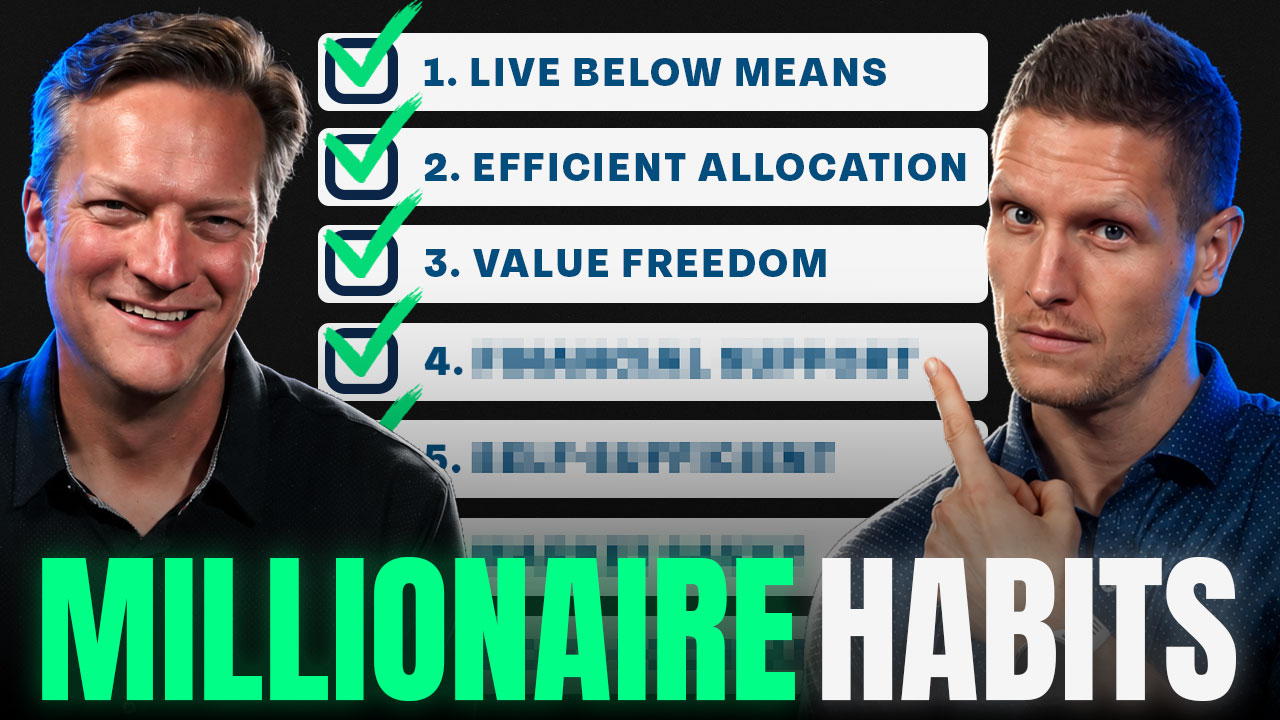
Are You a Wealth Builder Or Buster?
We don't want no scrubs! In this special livestream, we break down 7 habits of wealth builders and everyday millionaires - from living below your...

Episodes
They Want to Retire Early. Their Lifestyle Says Otherwise.
Can this couple retire early while traveling, raising kids, and enjoying their money today? Gina and Jaime want to retire early, but we show them...

Episodes
If You’re Between 32 and 48, Don’t Screw This Up
Rising income, compound growth, peak career years. In this new episode, discover why 32-48 could be the most powerful decade for building wealth and how...