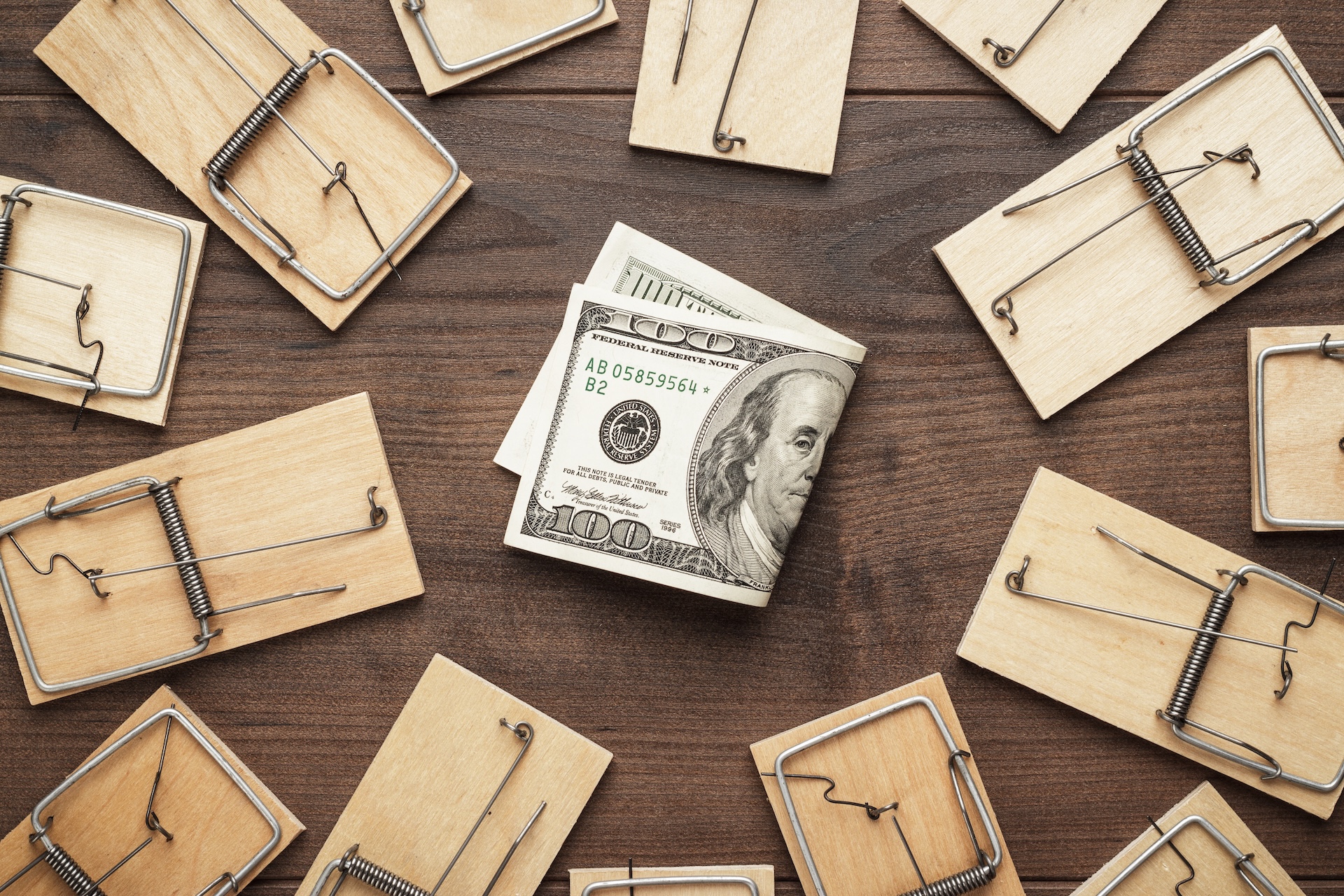

When it comes to building wealth, Americans are often their own worst enemy. On average, residents in the US have more disposable income than any other country in the world. Yet when it comes to personal savings rate, we are consistently near the bottom of the list, saving a measly 4.1% on average. The problem isn’t lacking the means to save, but facing unique cultural and societal roadblocks that prevent building any meaningful amount of savings. These are three of the biggest financial traps that keep Americans poor and how you can avoid them.
1. Gambling
10 years ago, it would have felt ridiculous to include gambling in a list of the biggest financial traps facing Americans. Sure, gambling was a big problem for a small percentage of the population, but due to the general illegality of sports gambling, save for a few “grandfathered” states like Nevada, it wasn’t an issue that affected a large portion of the country. That all changed in 2018 when the Supreme Court overturned the Professional and Amateur Sports Protection Act, which was enacted by Congress in 1992 to protect the integrity of sports in the US. This opened the door for legalized sports gambling, and has severely impacted the financial health of many gamblers.
Robinhood, now a small player in the sports gambling space, was released on the app store in 2014. They’ve spent the last 12 years building a sizable base of users, almost 30 million, making money when users trade stocks or crypto. Robinhood introduced gambling in the app, called prediction markets, in March of last year. In the second quarter of this year, barely a year after launching prediction markets, it is now generating more revenue for the company than trading stocks or crypto (but not as much as trading options). That’s how lucrative sports gambling can be – a company with no previous experience in the industry entered just last year, and the money they are making off gambling has already surpassed the business they’ve spent the last 12+ years building.
To put the amount of money Americans now gamble into perspective, the $166 billion in sports bets placed in 2025 is greater than the amount spent on movies, music, concerts, festivals, and books – combined. And it’s not even close. A better comparison is actually the amount of money we spend on pets. Think about how many people you know that have a dog, cat, fish, bird, snake, rabbit, spider, rat, or any other type of pet. Now think about all of the money they spend on their pet – taking them to the vet or groomer, buying food and other supplies, toys and accessories, boarding, and more. The total amount Americans spent on their pets in 2025, $158 billion, is still less than they gambled! And unlike our pets, gambling doesn’t provide us with unconditional love.
There is nothing wrong with gambling small amounts of money if you are investing 25% or more for retirement. But the only way to “win” at gambling is to avoid it entirely, which is especially prudent if you may be prone to addiction. Sports gambling has and is destroying many lives in the US, not just financially, and should be approached with extreme caution, if at all.
2. Credit card debt
You may not be surprised to learn that Americans still spend more on credit card interest every year than they do on gambling. It doesn’t help that credit card interest rates are higher than normal, and as most readers will know, they were never low. The average credit card interest rate in September 2026 reached 19.63%. That means for every $1,000 you carry in credit card debt, you’ll pay $196.30 in interest per year, on average.
Credit card debt is so harmful because of the punitive interest rates. The percent charged in interest is higher than any return you can realistically expect to earn investing in the stock market. Once you fall into the trap of carrying credit card debt, it can be extremely difficult to claw your way out. If you struggle carrying a balance on credit cards, we suggest avoiding them entirely. There are benefits to using credit cards, but no benefits are worth the costs you pay if you carry a balance.
3. Cars
We are a country that loves vehicles, which makes sense due to the vast size of our nation and lack of alternative long-distance (and often public) transportation options. You may not be surprised to learn that the amount we spend on transportation every year absolutely dwarfs the amount spent on gambling and credit card debt at $1.6 trillion annually.
Unlike gambling and credit card debt, though, much of the cost of transportation is unavoidable. Owning a car is often required to hold down a job unless you live in a city. Maintenance and fuel costs are not in your control, either. But you can control the type of vehicle you purchase, when it’s time to buy a new (to you) car, and you can control how many cars you own.
I was surprised to learn that nearly 25% of Americans own three or more vehicles – not households, but individual Americans. There are certainly justifications for one individual owning two cars, but at three and beyond it starts becoming more of a hobby and less of a necessity. There is absolutely nothing wrong with enjoying cars, and you can own 20 for all I care as long as you are investing 25% for retirement, but cars are unfortunately keeping many Americans poor.
In addition to owning a reasonable amount of cars, which is just one for most people, choose your car carefully. It’s as important as ever to choose a reliable vehicle that gets good gas mileage. The website CarEdge is a great resource to see which vehicles are more reliable and can meet your needs.
Americans have the highest income in the world, on average, but our collective savings rate is abysmal. I believe these three huge financial traps – gambling, credit card debt, and cars – have a large negative impact on many people’s finances. If you can do them the right way, you will likely find yourself in a much better financial situation than the average American.