
-
▼


-
▼


Want to retire early but worried your money is locked up until age 59 and a half? The good news is there are more ways to access your retirement savings sooner than most people realize, and you don’t have to break the Financial Order of Operations to do it. In this episode, we walk through five early retirement strategies, from the straightforward to the surprisingly complex, covering the pros and cons of taxable brokerage accounts, 72(t) distributions, Coast FIRE and more.
We break down the importance of recognizing that there is no one-size-fits-all approach and that optimizing your financial journey usually involves layering multiple strategies together based on your specific account types, tax situation, time horizon, and life plans. Whether you want to retire at 50, reach financial independence, or simply want the option to own your time sooner, this episode will help you build a more flexible financial future. Watch the full episode to find out which strategies make the most sense for where you are, and when you are ready to take the next step, become a client and let us help you navigate the complexity so you don’t leave anything on the table!
Enjoy the Show?
Where You Can Watch and Listen:
Subscribe on these platforms or wherever you listen to podcasts! Turn on notifications to keep up with our new content, including:
- Episodes of The Money Guy Show every Friday
- Episodes of Making a Millionaire every other Monday
- Mini-shows every Wednesday
- Ask Money Guy Livestreams every Tuesday
- Tons of other fun content!



5 Ways to Retire Early (0:00)
Brian: A lot of people want to retire early, but how do you actually access the money when it’s tied up in retirement accounts?
Bo: And Brian, I am so excited because today we’re covering five ways to retire early, including some that you may not even know about.
Brian: I’m Brian, he’s Bo, and this is the Money Guy Show, where two financial advisers share strategies to help you grow your wealth and get access to it when you actually need it.
Bo: Yeah, Brian. A lot of people want to retire early or at least they want the option to. They want to get to financial independence so that they then have the ability to own their time, to do what they want, when they want, and the way they want to do it.
Brian: But let’s face it, this system is designed for you to get access to your money after you’re 59 and a half. So what do you do if you actually want access to that hard-saved money much, much sooner?
Bo: And if you listen to us for any amount of time, you know we talk about the Financial Order of Operations all the time. We have a nine-step process to help you figure out what to do with your next dollar. And a lot of people say, “Okay, well, if I want to retire early, if that’s what I want to do, then I probably need to break the Financial Order of Operations in order for that to happen.” Brian, is that true?
Brian: No. I do not think you have to break the Financial Order of Operations, but it is going to require you to kind of use all the tools that are in the tool belt of the Financial Order of Operations. And with that, we’re going to give you all the different things you can do.
Should You Still Use Retirement Accounts? (1:28)
Brian: Because first of all, if you’re going to be going through the Financial Order of Operations, we still want you saving in these retirement accounts that have a 59 and a half or 55 access point.
Bo: Yeah. Why are retirement accounts a big point? For exactly that reason. There’s a good chance that you’re going to need these dollars even after age 59 and a half. We think so much about early retirement and what that looks like in our 40s and 50s, but there’s a big chunk of our assets that we’re going to need to optimize in our 70s, 80s, even 90s. So, why not take advantage of the accounts that are designed exactly to do that? And we’re going to show you today that there are actually easy ways to access these accounts earlier than just taking the easy shortcut of opening up a taxable brokerage account. So, we’re going to walk through five different ways that you can access your money that you may not know about.
Strategy #1: Taxable Brokerage Accounts (2:19)
Bo: And the very first one is utilizing a regular after-tax brokerage account.
Brian: Now look, we like after-tax accounts because these are still tax-favored. We’ll talk about how dividends can be lower tax rates, capital gains can be lower tax rates. But they don’t get the tax-deferred or tax-free growth that you see with a lot of the retirement accounts. So you better make sure you understand tax rates when we’re talking about investing in this structure.
Bo: Yeah. So a lot of people will say, “Okay, I’m just going to do the taxable brokerage account. I’m not going to do the 401(k) or I’m not going to do the other types of accounts.” Well, the reason you may be missing out on that is because historically, this is true now and it’s been true for the last 30 years: ordinary income rates are higher than capital gains rates. So, if I can save some money today and I can save at the ordinary income level, that’s likely going to be more advantageous to me than just saving in an after-tax account and being able to take advantage of long-term capital gains. Yes, long-term capital gains are favorable and they are a tax advantage, but it’s not more advantageous than actually saving money at the ordinary income tax level.
Brian: So, let’s talk about the benefits of using a taxable brokerage account because this is the easy button if you think about it. Hey, let’s go out and load up this after-tax account. But look, we don’t want you cutting the corner off, and that was the whole point we’re making. But we can start with the pros of this: it’s accessible for everyone. There are no early withdrawal penalties, there are no contribution limits, this is one that really does make it easy.
Bo: Yeah. It has a ton of flexibility in the fact that you don’t have to be working or not working in order to do it. You don’t have to be a W2 or a 1099 employee. There aren’t contribution limits. There aren’t age requirements. And we’ve already alluded to this: when you invest in an after-tax brokerage account, the gains on that when you go to sell the securities are taxed at long-term capital gains rates. They’re not taxed at ordinary income rates like the money that you pull out of your 401(k)s and IRAs.
Brian: And this is what we were talking about earlier on the con side of this: yes, there are tax-favored parts of it, but it’s just not as good. I mean, how do you actually compete with tax-free growth or tax-deferred growth for the next 20 to 30 years? So, that’s the part we want to cover. Yes, this might be a good bridge account and more to come on that, but we do want to make sure you understand that there are actually four other ways that you can get access to some of these more tax-favored accounts and that’s stuff we want you to lean into and pay attention to.
Strategy #2: The Rule of 55 (4:56)
Bo: All right, so strategy number two, again we’ve talked about this a little bit, but this is the rule of 55. And we won’t spend a ton of time on this one because this one is actually pretty straightforward. What it suggests is that if you are employed with the company that sponsors your 401(k) or your employer sponsored retirement plan in the year that you turn 55, you can begin accessing those dollars penalty-free before 59 and a half. But you have to make sure that you do not retire, do not leave work until the year that you turn 55.
Brian: Yeah, this is one that I want to clarify. It’s rule of 55. Not retire at 53, leave it in that account for two years and then pull it out. No, you have to literally be working at this company in the year that you turn 55 for this rule to actually work for you.
Bo: So, how do you need to structure your accounts if you want to do this? Well, obviously you’re going to need to be building inside of a pre-tax 401(k), inside a traditional 401(k) where you get a current year tax benefit. If you decide to contribute to a Roth 401(k), it can work. But you need to recognize that any dollars you go to pull out of your Roth 401(k) before 59 and a half, if any of them are earnings, they will be subject to taxes and penalties. So, you can only pull out your basis in the Roth 401(k). So, the best setup if you’re going to take advantage of the rule of 55 is doing so inside of a pre-tax 401(k).
Brian: So, let’s go through on rule of 55, what are the pros and what are the cons. For the pros, this is pretty simple. It’s a pretty binary decision of, hey, am I in the year that I turn 55 and did I have separation of service? If the answer is yes, hey, voila, you’ve unlocked where you have full access, immediate and full potential, without having to pay an early withdrawal penalty. And it’s tax-advantaged if your tax bracket is going to decrease in retirement. If I put money into my pre-tax 401(k) when I was in the 30% tax bracket, but then I retire at 55 and I’m going to be in the 22% tax bracket, obviously that was a more advantageous tax arbitrage that I was able to take advantage of.
Bo: Now, if we’re talking about the cons of this, it is dependent upon the plan design. When your company set up their 401(k), they did have to make the election to choose to allow the rule of 55 to be something available to their participants. And the other limitation is this has to be with your current 401(k), the actual retirement plan that you are currently participating in. If you have an old 401(k) or an old 401(k) that you rolled into an IRA, where those assets are now would not qualify. But there is a little bit of a hack. There is something you can do if you know that you’re going to retire and you do have other pre-tax assets or old 401(k)s or old employer sponsored plans. You can actually roll them into your current plan, thereby allowing you to access those dollars after you turn 55. But if you do not do that account consolidation, you do not roll them in, those other assets would not be available.
Brian: And this last con is Captain Obvious stating the obvious: you can’t retire until you’re 55. Remember, this is rule of 55. If your goal is to retire at 50, this probably isn’t for you.
Strategy #3: 72(t) Distributions Explained (8:09)
Bo: All right, so we’re talking about ways to retire early. And I don’t know if we did this on purpose, but we’re kind of going from least complicated to more complicated. Because obviously a taxable brokerage account is not all that complicated. Rule of 55, again, not all that complicated. You just have to turn a certain age before you access it. Now, this third one, this is one that I do think is a little more complicated. And if you read any sort of financial independence, retire early literature or do any research, you’ve likely come across 72(t) distributions..
Brian: And if you don’t love numbers, let’s give you an acronym: SEPPs. And what that stands for is Substantially Equal Periodic Payments. This is actually a setup. I’ll let Bo read the actual definition, but it’s going to allow you to have access to these retirement plans earlier than that 59 and a half without penalties. You know what? You don’t have to read it because I actually just gave it off of memory pretty much the exact same definition. I didn’t realize I was going to get it so close to the actual definition. I don’t do that very often.
Bo: So, how do you do this? How do you actually take advantage of Substantially Equal Periodic Payments or 72(t) distributions? Well, one, you need to choose what account you’re going to do the 72(t) from. Is this from a 401(k) that you’ve been participating in? Is it from an IRA that you rolled a 401(k) into? Is it just from a pre-tax IRA? You choose the specific account that you want to subject to this type of distribution. Then you want to choose the type of payment. And there are generally three different calculations you can do. You can do the RMD, required minimum distribution method, where every year the amount of your payment is recalculated based on the size of the portfolio and your life expectancy. You can do the amortization method, which is a fixed amount where it equally amortizes the amount that you’ll receive over a fixed period of time. Or you can do the annuitization method, which uses an annuity factor to calculate your payment based on your mortality rate, a chosen interest rate, and how much money you’re starting with. Each of these three different calculations will come up with three different answers for how much the periodic payment is going to be. So, you want to make sure if you’re doing this for early retirement that you choose the right calculation method so that you can actually meet your retirement living expenses. Then, once you set this in motion, you have to make sure that the payments continue for at least 5 years or until you turn age 59 and a half, whichever is longer. So, if you were to start a 72(t) at 57, you have to go past 59 and a half. If you were to start them at 45, you would have to execute them for 15 years. So you want to make sure your math is right before you jump in.
Brian: So with that, as you can see, just by the sheer fact that you have to choose what your distribution method is, there is a complication. Absolutely. And then the fact that you have to honor this 5-year or 59 and a half, whichever is longer, you can quickly see how this gets complicated. And then let me tell you how this actually works in practicality. A lot of times you’re trying to get to a specific amount of money that you need in retirement and you have this one big account. And if you calculate the payment off of that, you’re like, whoa, that’s way too much money. I don’t want all that money. So you have to then split the account out. You have to calc back into the much smaller account balance that you actually now want to make eligible to the 72(t). You can quickly see how this thing spirals into a complexity that you probably had not originally thought of, but still it is a viable option if you are leaving the workforce early.
The Pros and Cons of 72(t) (11:36)
Bo: And so if you’re thinking about this, is this something that makes sense for me? What are the pros and what are the cons? Well, obviously one of the pros is while you’re building up, while you’re saving, the accumulation process is pretty straightforward. You follow the Financial Order of Operations, you fund your pre-tax 401(k) account, and then when you get to retirement, when it’s time for you to start taking these dollars out, that’s when the complexity enters into the equation. They also have the tax advantage if your tax rates go down, because you’re essentially not having as much earned income. They can be tax-advantaged because your tax brackets will decrease in retirement. Now, as you can imagine, those are the pros, but there are some cons. And probably the first con is very obvious. There is a lot of risk in the complexity. The calculations on how much you should take can be difficult and if you mess it up, the penalties can be pretty severe. If you either stop the payments prematurely or you do not take a substantially equal amount that you’re supposed to take, they can actually charge you a 10% penalty retroactively for all of the years that you were executing the strategy. So, you want to make sure that you get this right on the front end and you actually execute it correctly.
Brian: Yeah. And then realize these don’t have a lot of flexibility in them once you kind of set it and forget it. You don’t get to change things. The distribution method doesn’t change. If you think about the fact that there’s a lot of market volatility and now that payment you calculated doesn’t work out to what you actually need to live off of, you have to start the process again with more of the previous account balance that you maybe had rolled an account off of. Or what happens if all of a sudden you have a windfall of money coming your way, whether it’s an inheritance or you start doing a side hustle or you do other things? Well, sorry, you started this process and you have to finish the drill. Because remember, it’s the longer of either 5 years or reaching 59 and a half. There are no takebacks on that.
Bo: Yeah. I think what’s really interesting as it relates to 72(t) distributions is they’re super interesting from like an academic and theoretical standpoint. When it comes to practice, we really just don’t see it all that often. And even for the people that are going to do 72(t) distributions, what they’re likely going to do is open up that separate account, put a smaller sum of money in there, and it’s only going to cover a portion of their needs. They basically create their own short-term fixed annuity to create that income stream. So for as much press and as much interest as 72(t) distributions get, I feel like in practice I just don’t see them really all that often across FIRE participants.
Brian: Yeah. So that’s 72(t). Still a viable tool though, because I do want to make sure we don’t poo-poo it too much. We do have clients that are using the strategy and using it effectively. We just want to make sure you go into it with your eyes fully open. But when I started podcasting all the way back in 2006, a lot of other financial advisors thought I was crazy for giving away so much free advice. And here we are 20 years later still loading people up with free calculators and resources and financial education. And the reason is we really do believe in the abundance cycle.
Bo: Yeah, we know a lot of you will use this information to help you build your wealth and that makes it all worth it. But for some of you that knowledge works a little too well. Your net worth grows, your financial life gets complicated, and one day you realize you need to take the relationship to the next level. And when that day comes, we would love for you to come back to where it all started, the Money Guy Show and Abound Wealth. That’s right. We’re fee-only and we’re fiduciary advisors, meaning we put your interest first and our goal is for you to rest easy knowing every box is checked and your army of dollar bills is working efficiently. So, if you’re at that point, go check us out at aboundwealth.com or click the link below. We’d love to connect and see if we are a good fit for you.
Brian: And that’s what we always talk about, the abundance cycle. We help you build wealth for free. And if you ever need a professional to take you to the next level, we’re right here and we’ll leave the porch light on for you.
Strategy #4: Roth Conversion Ladders (15:33)
Bo: So if 72(t) is one that gets a lot of press, this fourth strategy also gets a lot of press. And this is executing a Roth conversion ladder in order to be able to access your dollars early.
Brian: Yeah. Now, this one’s interesting because we all know when you start saving and investing, especially if you have an employer retirement plan, it’s not uncommon that you look back one day because it’s so tax-favored and you go, man, I have a huge tax-deferred retirement account, but I’m planning on leaving the workforce at 53 years of age. What am I going to do to get access? And then there is an option where, and I think I love that the FIRE community, or the retire early or move on to the next endeavor community, has said, hey, there is a loophole in the fact that if you do a Roth conversion and you turn some of that 401(k) or that rollover IRA and convert it into a Roth, if you keep it out there for 5 years, you can actually get access to that money even if it’s before 59 and a half, because that’s now basis. That’s intriguing.
Bo: That’s right. A lot of people don’t recognize one of the little-known things about Roths is even though they’re supposed to be used for retirement and 59 and a half, any money that you put in, any money that you contribute, is considered basis that you can access pre-59 and a half with no tax and no penalty. Well, when you’re doing Roth conversions, exactly what Brian said, now you’re just adding to the basis. So, what are the logistics? How does it actually work? Well, step one, you contribute into your 401(k). And this year you can contribute up to $24,500 into the pre-tax traditional side of your 401(k). Then as you get closer to retirement, you choose to convert a portion of that 401(k) to Roth. You’re going to pay taxes on the converted amount and then that becomes part of your Roth basis. But you have to let it sit in there for five years. You can’t convert today and then draw money next year. You have to let it season. If you let it season, then you can draw it penalty-free and tax-free. You repeat steps two and three annually for as many years as you need to create distributions for.
How a Roth Conversion Ladder Works (17:31)
Brian: So let’s take a visual example of somebody who’s taken years and decades to save and invest and has built up a traditional 401(k) and then they determine, hey, five years from now, I think that the amount of money I need to kind of bridge my early retirement is $30,000 a year. So what they’ll do is, five years from the day that they actually think they want to retire, like say in this example, 2024, when they’re 50 years of age, they’re going to convert $30,000 into a Roth. Now they’re going to wait the five years. So in 2029, they will now have access to that $30,000 because they waited the right holding period. Now they have access to what’s in the government’s eyes the basis in this Roth conversion. And then they’ll repeat that process for when they’re 51, 52, 53, 54. And you’ll see that this is actually going to be the bridge account that’s going to fund $30,000 a year, available to them all the way until they’re age 60, which ding, ding, ding, now you’re north of the 59 and a half and have access to all of your retirement assets. So just initially this seems interesting and we love the idea of turning what is that $180,000 into Roth dollars. But here’s the issue. Every year that you were converting from age 50 to 55, you had to pay tax on that conversion. So $30,000 got added to your ordinary income tax. And then you began drawing off that Roth basis in years 55 through 60. What I’m going to argue is that if you had money to pay the taxes on the conversion, you probably could have built an after-tax account instead of doing the Roth conversion. I can’t help myself. I got to throw it out.
Bo: Okay, you’re doing this way out of order. Let’s at least give them the pros and then I’ll let you unleash a little bit more when we get to the cons. The pro is exactly what we are laying out there. You know, the cool thing about it is in 2010 they changed the rules on Roth conversions. This thing used to have a limit. If your income was like over $100,000, you couldn’t do this. In 2010, they made it where there’s no income limits on Roth conversions whatsoever. So that means whatever you need, you can convert, with the little caveat that you better have the money to pay the taxes. And this also can be very tax-advantaged if your tax brackets reduce in retirement. Now, look, Bo will say that pro that I just read out to you is probably a con because for most people, when you’re in the last few years of working, you’re actually in your highest earning years. So even though I said this is a benefit, it’s really only a benefit if your taxes go down later in retirement. It’s actually a negative. And that’s why I’ll probably open it up to Bo. What are the cons, Bo?
Brian: Yeah, most likely you’re going to have a high tax bill if you’re trying to do these conversions while you’re still earning income. You’re going to be converting, you’re going to be paying tax on that. Even if you’re someone who says, “Oh no, no, that’s not the strategy. The strategy is I’m going to retire at 50 and then I’m going to be in a low income tax bracket. I’m going to do Roth conversions.” You’re likely still going to have to come up with money to pay those taxes that could have served as a bridge. So, I think it’s again a fantastic exercise, but in practice, it often falls short. And you have to remember there is this 5-year delay. If you want to be able to take advantage of this, if you want to do this, you have to be planning at least 60 months in advance to be able to get access to that basis. And then I’ll just state the obvious. If you ask me who my favorite child of my tax-saving children are, it’s going to always be Roth accounts. It’s so interesting: if you think about the order that you save retirement assets, there’s a reason even in the Financial Order of Operations we tell you to fund in step five the Roth account. But you know what happens typically if you think about the order of when you fund your retirement savings? You typically go Roth, which is tax-free, then you go to 401(k), which is kind of tax-deferred because that’s where the employer match is, and then the last account typically around step seven of the Financial Order of Operations is your after-tax brokerage account. And then what I find interesting, maybe because I come from a public accounting background, is that we did it in that order. We went Roth, tax-deferred, after-tax. That was the way we funded these accounts. When you hit retirement, from an inventory of where you pull those assets out, you typically then go taxable first, then tax-deferred, because you want to start doing Roth conversions and other things before you have to do the required minimum distributions. And the last account most people don’t want to take assets out of is the Roth because it is your precious. It grows tax-free and it even grows tax-free from a legacy standpoint. So if you think about leaving the kids some money, you start looking at all of your assets and you go, which one would I want my son, my daughter to inherit? Well, the Roth is the coolest because it at least has a 10-year extension of the tax-free growth. It’s pretty sexy from even a legacy standpoint. So, I don’t mean to give it so much lip service, but a big con is that you’re giving up your prized favorite tax investment child.
Strategy #5: Coast FIRE (22:56)
Bo: So obviously, normally when we’ve done these shows in the past, this is kind of where we stopped. Hey, four things or four ways to retire early that you may not have thought of. But there actually is a fifth one. And this is sort of a different type of retirement, but again, this one has had a lot of press and a lot of attention over the past couple of years. And this is for folks who want to do some version or some variation of Coast FIRE.
Brian: I just had a call yesterday with a client who’s been with me for quite a while and she’s just at her wit’s end. She doesn’t like the area she lives in the country anymore. She doesn’t really love her job anymore, but she’s done a fantastic job of building up assets in the background. And I could tell she was getting overwhelmed in the situation. And I asked her, I said, “Have you ever heard of Coast FIRE?” Now, she had not, but I was like, “Let me tell you how this is going to work. You have done such a good job of building up assets, but I can tell you are straight up miserable with where your life is going right now. We’re going to use all that goodwill of building up all those assets. What if I told you we could start doing an exercise where we start looking at different parts of the country you could live? What if we start looking at you don’t have to make the same income you’ve been making? You can switch careers to a lower paying job that just covers your living expenses because we’ll just quit saving and investing for the future. You’ve already done that hard work. We’re going to coast to the finish line because what you’ve done will get you there.” You should have seen the relief. I turned a frown upside down and I was so happy. So, that’s why I know a lot of people call us the fire extinguishers because they say when we talk about FIRE content, we always have this edge to us. The edge is only conservatism. We just want to make sure that when you go through that threshold of retirement there are no regrets because usually it’s hard to get the water back up the hill. But I do use this as a tool for my clients. If there’s any way I can tell you, hey, be rewarded for your hard discipline in the beginning but live your best life instead of suffering through it for another 7 to 10 years, we are going to do it. And I think Coast FIRE checks a lot of those boxes.
The Pros and Cons of Coast FIRE (24:57)
Bo: Yeah. Coast FIRE is exactly that. It’s the idea that while you’re in your highest income-earning years, you’re going to save as much money as you can to hit a certain number that will allow you to then shift gears, downshift, move into a more enjoyable job, enjoyable career, until you ultimately get to where you’re truly financially independent. And so one of the huge benefits of Coast FIRE is that it does improve your work-life balance earlier than full retirement. But you likely are sacrificing some work-life balance early on. You have to have a very high savings rate. You have to be able to do very hard work early in order to give yourself the margin to be able to do that downshift. But when you do it and when you do it well, it does allow you to enjoy spending now. If you can save up all the money that you need to save and then you can just find a job that allows you to pay your bills and keep the lights on and maintain the lifestyle that you want to live, you get to actually spend now and begin enjoying the fruits of your labor earlier than if you’re waiting till full retirement to be able to do that.
Brian: Well, also what I like is that there’s comfort in knowing that you’ve kind of done the heavy lifting already and you’re getting a reward for that discipline. You’ve front-loaded. Now you’re actually getting a dividend off of that hard work much, much earlier. But Bo, with all that, we just put some roses on this thing. What are the cons?
Bo: Yeah, the big one is a lot of people don’t do the math right or they’re too aggressive in their math and they arrive at the conclusion that they take their foot off the gas too early. You know, I’m going to Coast FIRE. I built up $100,000 and I’m 35 years old. I’m going to coast now. Well, if you’ve done the math poorly, there’s a good chance that $100,000 at 35 might not turn into what you need it to turn into by the time that you turn 65. So, you want to make sure you measure two, three, four, five times before you stop saving before you leave that high-earning career. And you want to make sure that you have enough conservatism built in that you’re prepared for any unknown unknowns that might come your way.
Brian: The other thing to take into account is how long is your time horizon? Because one of the things we always make sure we bring forward for people to consider is if you’re making this decision before you’ve closed out all the decisions on how big is your family going to be, how are you going to pay for, or have you even had that discussion on what higher education looks like for your children? Where are you going to retire to? Because if you’re moving to a high cost of living area, what does that do to your plan? I always say look at your time horizon. There are too many variables that can change. It makes the planning for this much, much harder. So that’s why you have to make sure you measure twice, cut once. And that’s where that conservatism comes through to make sure your variables are right so that you don’t have a disappointment after you make these big heavy decisions.
Which Early Retirement Strategy Is Best? (27:49)
Bo: So if you’re going to retire early and that’s something that you want to do, which one of these five is the most optimized path? Which one is the one that makes the most sense? Well, the answer is there are a lot of factors that will change the outcome. And the right solution for one person may not be the right solution for another person. So, what are the things you ought to think about? What are the things you ought to look at? Well, you ought to think about your tax rates both now and in the future. How much are you actually going to spend in retirement? Where’s that going to put you from a tax bracket standpoint? What is your tax rate before retirement? What will it be after retirement? Where are you going to live? Are you going to live in a low tax jurisdiction or a high tax jurisdiction? What types of accounts do you have access to? Are you single now and you’re going to be married? Are you married now and perhaps you’re going to be single? You want to make sure you understand those things because those are very much going to impact the mathematics of whether your plan is going to work or not.
Brian: Yeah. I mean, this is one of those things where I tell people, you have a simple financial life and you can create tremendous success with simple small decisions, but at some point complexity finds you. Success creates complexity. And guys, I’m here to tell you when it comes to retirement planning, this is one of the more complex things that you deal with because as we’ve already covered, your tax structure matters. Do you have all after-tax assets like a taxable brokerage? Did you load up only on Roth because you heard us say it was our favorite and that’s all you’ve got? That’s probably actually the worst situation, if I’m being honest. Or maybe you have too much of the tax-deferred where you can’t even pay for cars in cash because you’re retirement-rich and don’t have other assets. All these things, we accept people for how they come to us and then we try to help them live their best life.
Why Combining Strategies Can Work (29:39)
Brian: But the reality is personal finance is very personal. And that’s what I always tell people: this is the part where I always like to reach people and say, look, it’s not one, two, three, or four and you definitively just choose one of these strategies. What I like is as a financial planner, we layer these strategies. Because I look at it and I say, hey, you know what, it looks like you have this 401(k) and you’re retiring the year you turn 55. The rule of 55 is going to be your friend, but it’s not going to cover everything. But that’s okay because we have this after-tax brokerage account. Or what if you have the 50-year-old and you say, you know, let’s do a portion of this with a 72(t), but once again we’ll fill in the portion because we don’t go too big on the 72(t) because you’re making a promise to yourself for like a decade on this thing because we have to wait until we’re 59. How about we load it up with some more taxable brokerage assets? All of these things can work in unison with each other as long as you’ve got a quarterback that will help you navigate this.
Bo: Yeah. And that’s exactly when we think it might make sense to take the relationship to the next level for you. If you’re retiring early, there’s likely a truth that you’ve only retired early one time. You’ve only ever had to navigate one retirement, but we have been able to help thousands of people get to that point and navigate through that threshold. And we love giving away this free information. We love that we can load you guys up with it. But we want you to remember when you get to the point where your life gets so complex or you just want to make sure you’re not not knowing what you don’t know, we’ll leave the porch light on for you.
When Retirement Planning Gets Complicated (31:18)
Brian: I think it’s interesting. I had a dear friend reach out to me getting advice because they knew Millionaire Mission had been successful and wanted to get my take on doing a book deal. And I was like, “Why are you trying to do this by yourself?” I was like, “If you look at your the business you’ve built, and just like if you were the individual looking at the retirement you’ve built, this is novel to you. You’ve never done this. Why would you try to do this all by yourself when you just don’t know what you don’t know?” I was like, “When I got into this situation, I hired somebody to help me navigate this who had literally done this thousands of times.” And that’s what I would ask of you guys. If I was willing to pay what I needed to pay to my agent to help me navigate this, I think the same correlation can be made to your retirement. You don’t know what you don’t know. And that’s the risky part. So, why not bring somebody who you know is good with money? You’ve watched our content. You’ve seen the abundance cycle in action where we literally give it to you, overwhelm you with value so you can become the best version of yourself. It’s just when you reach that level of complexity, give us a shot. Come become a client. I’m your host Brian, joined by Mr. Bo. Money Guy Team, out!
Free Resources


Free Resources
Financial Order of Operations®: Maximize Your Army of Dollar Bills!
Here are the 9 steps you’ve been waiting for Building wealth is simple when you know what to do and the order in which to...

Free Resources
Wealth Multiplier By Age
If you want to set yourself up for future success, find out how much you need to save every month to become a millionaire.

Free Resources
Car Buying Checklist
Here’s how you can buy a dependable car that won’t break the bank. Our free checklist walks you through the 20/3/8 rule and strategies to...
Articles


Articles
How To Win With Money in Your 20s (and Set Yourself Up for Life)
The first decade of adulthood is one of the most important periods of your life. The course your life takes when you are younger can...

Articles
How To Get Affordable Health Insurance in 2026
Health insurance premiums may make up a significant portion of your budget. How can you find more affordable health insurance? Is it ever worth going...

Articles
6 Financial Changes To Make in 2026
There is no need to wait until an arbitrary date on a calendar to make positive changes in your financial life, but if you are...
Financial FAQs
Courses & Tools

How about more sense and more money?
Check for blindspots and shift into the financial fast-lane. Join a community of like minded Financial Mutants as we accelerate our wealth building process and have fun while doing it.
Free Resources
Financial Order of Operations®: Maximize Your Army of Dollar Bills!
Here are the 9 steps you’ve been waiting for Building wealth is simple when you know what to do and the order in which to...
Free Resources
Wealth Multiplier By Age
If you want to set yourself up for future success, find out how much you need to save every month to become a millionaire.
Free Resources
Car Buying Checklist
Here’s how you can buy a dependable car that won’t break the bank. Our free checklist walks you through the 20/3/8 rule and strategies to...
Recent Episodes

It's like finding some change in the couch cushions.
Watch or listen every week to learn and apply financial strategies to grow your wealth and live your best life.
Episodes
Are You a Wealth Builder Or Buster?
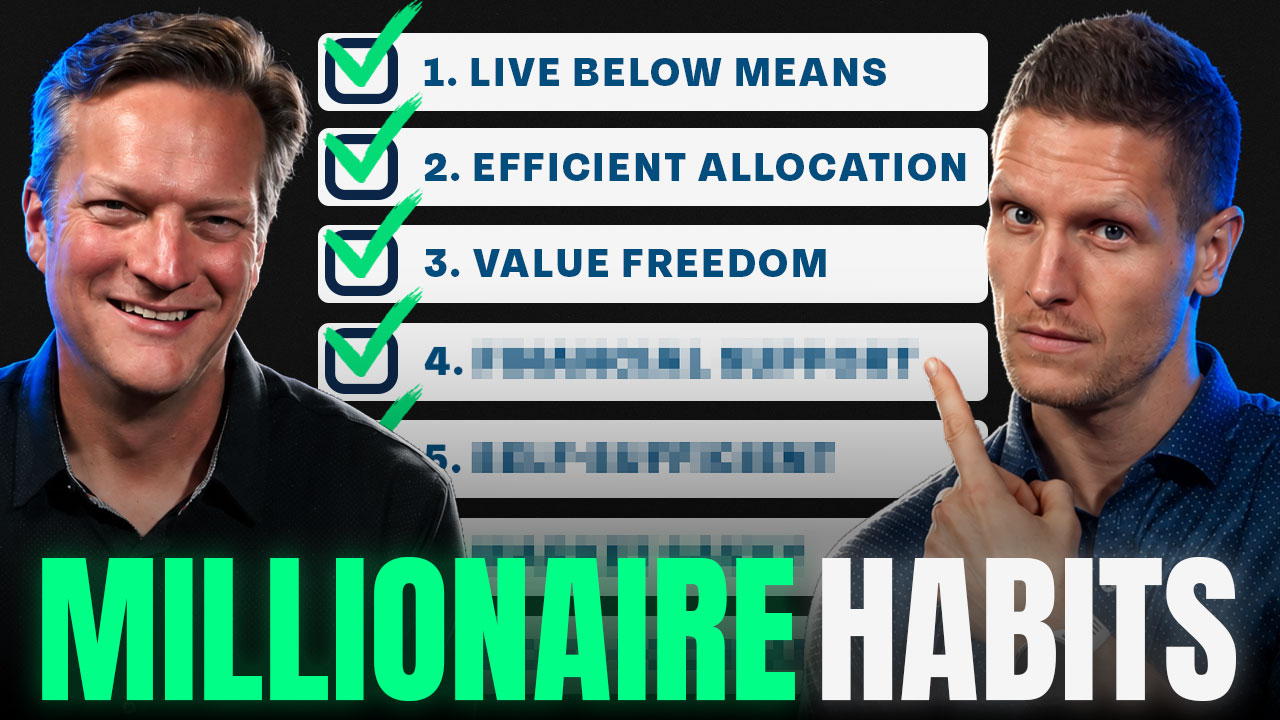
We don't want no scrubs! In this special livestream, we break down 7 habits of wealth builders and everyday millionaires - from living below your...

Episodes
They Want to Retire Early. Their Lifestyle Says Otherwise.
Can this couple retire early while traveling, raising kids, and enjoying their money today? Gina and Jaime want to retire early, but we show them...

Episodes
If You’re Between 32 and 48, Don’t Screw This Up
Rising income, compound growth, peak career years. In this new episode, discover why 32-48 could be the most powerful decade for building wealth and how...