
-
▼


-
▼


Retirement happiness isn’t just about how much money you’ve saved, so what actually matters most? We are joined by special guest Wes Moss, retirement researcher and author of the Retire Sooner Method, to put this theory to the test with a Retirement Happiness Draft. Taking turns building our ideal retirement from 12 options including $100k of annual income, eight hours of sleep, a paid-off home, and multiple income streams, we reveal who builds the happiest retirement and why.
Wes also unpacks new research on what actually separates the happiest retirees from the unhappiest ones, including the role of core pursuits, community, the friendship recession in America, and why purpose in retirement is not found but created. And if you want to grab Wes’s book before it drops on September 1st, head to RetireSoonerMethod.com for preorder bonuses including a workbook, a secret color chart library, and more.
Then we answer your live financial questions covering the order in which to draw down your accounts in retirement to minimize taxes, whether to switch from an HSA to a Cadillac plan in a year when you’re expecting a baby, how quickly to rebuild your emergency fund after a drawdown, when and how to shift from aggressive to more conservative investments at 58, and more! Explore all of our free resources to make sure your retirement plan is built on more than just a number.
Enjoy the Show?
Where You Can Watch and Listen:
Subscribe on these platforms or wherever you listen to podcasts! Turn on notifications to keep up with our new content, including:
- Episodes of The Money Guy Show every Friday
- Episodes of Making a Millionaire every other Monday
- Mini-shows every Wednesday
- Ask Money Guy Livestreams every Tuesday
- Tons of other fun content!



Welcome Wes Moss and the Happy Retirement Draft (0:06)
Brian: Do this for a happy retirement. Just like your favorite Scooby-Doo episode, we’ve got a special guest today with Mr. Wes Moss.
Wes: It’s so cool to be here, and I’d love to be in the same camp as Scooby-Doo.
Bo: Wes, we are so excited to have you here today because we’ve known each other, how long has it been? It’s been over a decade. A decade ago, right?
Brian: Yeah. And you’re a pretty big deal in Atlanta. I know for us, when we were like, oh my God, first in 2015, I felt like we saw you at FinCon and from across the room I was like, that’s Wes Moss. We were so excited because we’re Atlanta boys. You are a huge deal. And then you’ve also gotten into the digital world. But if you’re from Atlanta, Wes is all over WSB. He gets to hang out with all the cool guys like Clark Howard. But you’ve now conquered the digital world too. Being Atlanta boys, we were really excited the first time we got to hang out.
Wes: Well, you guys are the ones that probably got me into podcasting. I was looking at your wall of your history wall, which is cool and confusing a little bit, because you’ve got 2006 and then 2008. Bo, you moved to Franklin. Brian, you moved after. But you started in ’06 originally, and I started in radio in Atlanta in ’07. WSB starting in ’09. So you were before me in the media game. And then you guys transitioned. There was probably 12 people watching that podcast back in 2006.
Brian: But then you guys have really, it’s actually I’ve been doing a lot of extra study about the Money Guys in the last couple of days, and you guys have just exploded. You’re like an overnight success. I know it’s been in the making, but it is incredible. And I’m excited. Super psyched to see that everything you guys have done. You’ve got an awesome audience, a great firm. Your book has the most incredible reviews. I’m so jealous. I’m going to start blushing. A thousand reviews. There’s no non-five stars except for if they had shipping problems.
Brian: There was only one. I keep reporting that one guy whose book got chewed up and he gave it one star. And there was one four-star review, and the complaint was that it’s not in Mandarin. It was from China. I was like, that’s a tough audience, man. You ought to do an audiobook.
Wes: God bless you. Awesome. So you’ve got this new book. Give us the rundown. What’s the new book about? Give us the idea around it.
Wes: I started this research and writing back in 2011, 2012, trying to figure out what I wanted. If I was going to be writing about something, I wanted it to be about the data. A lot of the financial shows I do, I almost always start with the data and then try to allow that to formulate a story that is as objective as possible. Of course we’re going to have our opinions, but I always feel more confident if I can just start with the stats. And it’s the same thing when studying populations of success. Because in the end, beginning with the end in mind: we want to be able to have financial freedom and a happy retirement. It’s not about the amount of money. That’s not where I start. It’s really about finding the population, studying them, segmenting the happiest group versus the unhappiest group, and then just learning what that happy group does and what the unhappy group does, and then being able to compare the two. That was originally how my first book, You Can Retire Sooner Than You Think, came about. It was really researched first and then I was like, there are so many things to learn here from this population that it became a book. Then essentially ten years later, it had gotten old. The numbers were old, the statistics felt old. The world had changed a ton. We went through many bear markets, a hyperinflation scare, the pandemic. I felt like what I was known for, those statistics, were just old. So I tried to update that book and I spent a year updating it. And one day I was at my kitchen counter and just said, you know, this update sucks. I was like, this just is not good enough. And so I said, I really have to start over from the very beginning. By that point it was eleven years. I was like, it’s getting further and further and older and older. So I was nervous to start all my research again because what if it contradicted what I said ten years ago? I don’t care. Whatever it is, it is. And the good news is almost everything was in line with what I had found a decade prior. But the numbers changed, and that makes sense because we’ve had a lot of inflation. People reported having more money in the happiness zones than they did eleven years ago. I also found more fear. I was able to understand what is keeping people up at night more today than ever. I studied community more than I did in the first couple of books, and socialization, and realized that we’re in a friendship recession in America. The community part of having a happy retirement full of freedom is so big, and I realize how much people are struggling with that. We know demographically it gets even harder as we age. There are all of these factors that hit us when we’re in our mid-50s and then accelerate into our 60s and 70s that create a real headwind to continuing to have the same level of joy, purpose, and happiness in those stages of retirement. And that’s what the Retire Sooner Method teaches: yes, there are some chapters about the finance side, but the lifestyle side is so important because in the end, that’s what we’re all after. We want to have this purpose-filled, amazing next phase.
The Happy Retirement Fantasy Draft (7:52)
Brian: Well, we decided because you’re now on your third book on pretty much making retirees happy and how to have the best success in retirement, why not gamify this? So much of life is gamified. We did this with Austin and Robert from Rich Habits on another concept on retirement, but it wasn’t the tools. It was financial tools. So we had the team put together all these different options. Now a few of them are kind of there to lead us down the wrong path. You’re the expert on this, but we’re going to do a snake draft. You’re the guest, you’re going to choose first. We’re drafting like a fantasy football build-the-happiest-retirement. That’s the goal. What would it take to be the happiest retiree? We’ve got twelve different options. We’ve got luxury vacation homes, $100,000 annual income, eight hours of sleep, travel and experiences, five close friends, living near family, paid-off home, hobbies and volunteering, daily physical activity, a flexible schedule, three income streams, and a weekly dinner group. Each of us gets to choose three. You’re going to go first. Bo goes second. And I’m going to go last.
Bo: We always make Bo go last so we can pick on him.
Wes: Okay. I’m thinking the long game here and I might make my pick to throw you guys off. I am going to start with what seems like the twelfth person in the draft, which is the weekly dinner group. Honestly, I was not guessing that was going to be your first draft pick.
Brian: All right. I’m going to go with the happiness factor first. I’m going with five close friends.
Bo: All right. I can’t tell if you guys are being legit or if you’re just trying to do this for the audience, because I’m going to go right off the bat. I know the number one thing that most people struggle with when getting to retirement is: do I have enough financially? Am I going to be okay? So my very first pick is going to be a financial pick, and I’m going to lock in $100,000 annual income. I’ve got baseline coming in guaranteed. Like Forrest Gump would say, that’s just one less thing. I’ve got money coming in.
Wes: Now that I’ve done that, my second pick is going to be daily physical activity. I do believe that health is wealth. There’s no point in having all the money in the world to do all the things in the world if you don’t have the health to be able to enjoy it. So I’m going income and then daily physical activity.
Brian: I want some income because I’ve got the friends, so now I need to be able to fund us doing activities. I’m going to do three income streams. And I’m hoping mine is even more than $100,000. I didn’t pick that because three income streams could be $100 a month. We don’t know what that is, but I’m involved, so it’s going to be successful.
Bo: You guys have left $100K on the board and I’m going to snag that. No wait, he already took that one first. Okay, so luxury homes are still hanging out. That looks like an albatross. That’s a bad first round pick. I like that you guys put that as number one. I’m going to go with living near family. That’s a really good one.
Wes: This is my last one. I’m going to take the last financial pick, which is paid-off home. I’ve got shelter for life, no worry.
Brian: All right, Brian Preston gets the last one. You had five close friends and three income streams. You know what? This works out beautifully. I’m going to focus on some health. It will not have the bench press that Bo has, but eight hours of sleep is my last one.
Wes: That’s the happy retiree superpower, by the way. I’m telling you, I have stacked the deck here. It’s two to one. The happy retirees say they get enough sleep, two to one relative to the unhappy group. So it’s over 80% of happy retirees say they get enough sleep, and only 41% of the unhappy group. And it was self-declared, so I asked not about the hours but whether they felt they got enough sleep.
Bo: So I get the last draft pick. And honestly, because this is one of the things that I want to do one day if I ever actually do retire, I’m going number four: travel and experiences. I’ve spent all this time building up all this wealth, working so hard. I actually want to be able to enjoy it, want to be able to travel, take my family to places I’ve always wanted to go.
Who Won the Happy Retirement Draft? (15:28)
Wes: So when you look at these three different camps, here’s what I’ll say. I was at a golf tournament a couple weeks ago. It was old guys versus young guys. There were 50 golfers in each big group and it was a two-day tournament. At the end of Sunday, the young guys had 687.2 points and the old guys had 687.2 points. Everyone hated that. You’ve got to have a winner. My point is that these are very close, but we still need to have a winner. And because I’m the guest, tie goes to the hosts. So I’m going to say I don’t win. But here’s my editorial comment. Bo makes $100,000 a year of income. He’s obviously very active, making the Instagram posts, traveling the world. But he’s a lonely vlogger with no friends. He has an audience that’s not a following. You ever go to the gym, bro?
Brian: Yeah, he’s out there on the beach, he’s beautiful, but he’s very lonely.
Wes: Okay, let me criticize Brian for a second because I think he’s one of those vloggers too. With an Instagram page, he’s got a lot of followers. But does he have a lot of real friends? The five close friends thing you nailed, Brian. By the way, I did weekly dinner group as a substitute for that, because here’s the problem with five close friends today: it’s great and it’s essential. But friends move, friends die, friends get hurt, and you have to continue to replenish that. A weekly dinner group is an evolving group that can change. Different people coming in. Part of maintaining that community is to have a flexible amount of community that can continue to expand if somebody goes away, moves, gets divorced, et cetera. So I’m going to beat you on that one. Three income streams: what are they? What if they’re all like $100 a month? And eight hours of sleep is a good pick, but I don’t know if that’s enough for you. I’m going to say Bo wins, I come in second because I’m an evolving community. And actually, Brian wins. Bo is second.
Brian: Wait, you said it first. Bo wins or Brian wins?
Wes: Brian wins. Bo second. And I’m third because I’m the guest. Here’s the thing about your five close friends: if they’re still working and you’re retired, you know what I mean? You’ve got to have five close friends in the same financial situation who can enjoy it with you.
Wes: One of the things that is one of the what I’ve noticed over the last 20 years is that we think about finding our purpose as this passive thing. And that’s a great concept, but purpose doesn’t come and knock on the door. In reality, it is created. It is up to us to create a new purpose. That’s one of the reasons behind having five-plus core pursuits, which I talk about in the Retire Sooner Method. The happy group spends almost 20 hours per week on these pursuits versus 13 hours for the unhappy group. The happy group is creating their purpose through what I call super activities, core pursuits, hobbies on steroids. And that takes some work. It really takes some insight and introspection to figure out: what is my new schedule going to look like? Do I have five, six, seven, eight of these super activities that are helping me create my daily purpose?
Brian: That comes around to the reason I love what is coming out, because it pays so much homage to the abundance cycle. And then even Brian brings up a really interesting point. This is a question that was asked through the research: are you able to say yes to this question, “I am retired and I’m in a position to not have to work, even though I may be working.” It really is a financial freedom question. For those in the non-retired group and those in the retired group relative to the happiness baseline, there’s a 21% jump when you say, I’m in the position to stop working. Financial freedom: it’s huge. It’s one of the reasons why we do this. We do believe it’s possible and it’s attainable and something that everyone can achieve. That’s why we choose every Tuesday at 10 a.m. to show up right here to answer questions and load our folks up.
Rebie: I’ve got a retirement question queued up from Travis. But first, to my Money Guy family: remember to go to moneyguy.com/earlyaccess today if you haven’t already, because we have a big announcement going on behind the scenes. We’ve already had two hints sent out to the list. We’ve got a third one coming very soon, plus actual early access to the secret project. And I can share one thing: whatever the secret project is, it’s completely free. It’s completely free. So go to moneyguy.com/earlyaccess, get on that list today so you can actually see that third hint drop, be part of the guessing, be part of the secret channel in the Moneyverse, and actually be the first to know and get the early access.
Q&A: In What Order Should I Draw Down My Accounts in Retirement? (24:27)
Rebie: All right. Let’s head to Travis’s question. He says, “Once I retire, in what order should I draw from my taxable brokerage, traditional 401k or IRA, and Roth accounts to minimize taxes?”
Bo: Yes, we do talk about this question all the time. We talk about: when you’re building, when you’re saving, when you’re adding in retirement, there’s generally an order that makes sense to follow. We call that order the Financial Order of Operations. If you’re following it, you’re likely naturally filling your buckets in that way. You’re getting money in the Roth first, then the pre-tax, and then usually last, you get money in the after-tax bucket. When it comes to distribution, where do people’s money actually come from when they start creating an income stream? Wes, where do they think about pulling the money out?
Wes: It’s a smart question, and I would say the unsung hero when people stop working is the management of your tax bracket. We have so much control once we have stopped wage income. We’ve got distribution. We can choose which accounts we want to take out from. There’s the Roth, right? That’s the crown jewel of all accounts because it all comes out tax-free and that’s amazing. So we could always look at that depending on the balance, depending on how large a piece of the equation the Roth is. But if we’re not talking about conversions and we stop working, I love being able to look at an individual account and see where I have gains or not. If I can manage taking $50,000 out and have zero taxes, because you’re essentially looking at positions that don’t have big embedded gains, then you can dramatically drop your overall effective income tax in retirement. You can be close to zero in long-term capital gains. You’ve got a lot of wiggle room, even taking gains, if your other income sources don’t get you over a certain threshold. So I like going to the taxable individual account first, supplementing with the Roth, and then at some point you’re going to have to take 401k money because of the required minimum distributions.
Brian: I’ll add a little bit of flavor to that. If you think about the Financial Order of Operations, you’re going to fill your Roth first because that’s step five. Then you’re going to load up the 401k and the traditional side, the tax-deferred. So that’s your second savings account. Then usually most people don’t get until step seven, where they really have the ability to start doing taxable brokerage saving beyond their emergency reserves. So you did Roth, traditional, then after-tax. In retirement, you go the exact opposite order. You go after-tax first, because exactly what Wes said: you can get access to that money very easily. And then I like Roth conversions because the second you’re probably going to have the ability, because of the income manipulation you were talking about, to do Roth conversions at a low tax rate. You’ll start turning that traditional into Roth assets. And then even after you’ve lived beyond the Roth conversions, you’ll probably start pulling out of traditional because you want to race the government to beat the required minimum distributions. So you’ll hit traditional and then save your precious Roth for last. Everybody in the FIRE community says, hey, you can go get access to the basis in your Roth. And you’ll want to, because your Roth turns into your legacy. I hate paying taxes. I want my kids to inherit this awesome tax-free growth. So the last account you’ll touch is your favorite child of the three accounts, which is your Roth. You’re going to do it the exact opposite way.
Wes: I agree. The only small thing I’ll add is that in practice, this is all academic and theoretical. In practice, the order changes a lot based on a number of things you have going on. When you take Social Security will affect when you begin to draw from different accounts. How you handle Medicare, whether you’re going to hit IRMAA surcharges. When you have to take RMDs and the size of your RMDs. Are you an early retiree who has to figure out how to stay below some subsidy level? Are you available for 0% capital gains? There are a number of different years, time seasons and periods where your strategy might change. It’s why personal finance is so personal. It’s why oftentimes this is the stage where it does make sense to reach out to a professional, because your strategy from 55 to 60 might look different than from 60 to 63, from 63 to 70, from 70 to 75, and from 75 all the way out to 100. You want to make sure you’re doing that well.
Brian: It’s not a one-size-fits-all. Well, I do what I can. Thank you for that. Well, Travis, just email winner at moneyguy.com if you would like a tumbler. And by the way, I’m doing a renewal on the tumblers. They’ve gone up 15 to 20%, so you’re now getting tumblers that are literally appreciating with inflation.
Bo: This is a tumbler. Do you want to tell him what’s so special about it? It’s actually a transforming tumbler. You are using it right now as a tumbler since it’s holding nice crisp cold water in it. But quack quack quack quack quack, it just shifted and changed into a koozie. It’s a dual purpose. It’s like the Swiss Army knife of beverages. And that’s a mustache on there, because Brian can’t grow a mustache. Neither can I, but I attempt to try. So I felt like to be in solidarity with my friend Bo, I would put a mustache on my tumbler.
Brian: There has been tumbler inflation. You are the beneficiary of that tumbler inflation.
Q&A: HSA or Cadillac Plan for a New Baby? (30:40)
Rebie: The next question is from River Sniper 09. It says, “Hello Money Guy team, currently expecting and due in March.” Congratulations! “We have an HSA with a $3,600 annual employer contribution. Recently you have mentioned Cadillac plans for years of birth and things like known medical expenses. Is it worth changing plans?” The classic question: should they keep the HSA or consider the Cadillac plan?
Brian: Wes, we’ve been out of the baby stage for a little bit. You’re probably the closest on this.
Wes: I’m ten years out, but I just kind of kept rinsing and repeating.
Bo: So we tell people obviously that it makes sense at annual enrollment to review which health plan makes sense every single year. It’s not a set-it-and-forget-it. And we love HSAs and high deductible plans because you’re able to get triple tax advantage: you put money in, it can grow, and you can pull it out tax-free. But in those years when you know you’re going to have big medical expenses, and for young people one of the biggest expense years you’ll have is when you start a family, if you have a highly subsidized, very low-cost plan, it can often be more expensive on the high deductible plan. If the coverage is great and you know you’re going into a year where you’re going to have those types of costs, it makes all the sense in the world to probably switch to the Cadillac plan, even if it’s a little bit more expensive from a premium, so that you can have those costs covered. And then once you’ve made it through that expensive year, next year you go right back to the HSA. But you’ve got to do the spreadsheet math: what are the premiums on both plans, what’s the tax benefit, what’s the employer subsidy, and then figure out mathematically which one puts you on top.
Wes: Yeah, I would agree with that. In real life, if you have a really expensive year, you might spend all of the HSA money and it might be gone in a year. And that’s the lumpiness of parenthood. I have four kids and I go back to some of those years. The initial year is always really expensive. Maybe the Cadillac plan works even better. But then you’ve got potential extra medical costs if you have a kid that gets sick, and you don’t know when or if that’s going to happen. I’ve had that happen in my family. You really have to assess your family situation.
Brian: I would be curious about the $3,600 employer contribution, which is huge by the way. That’s incredibly generous. Most employers are usually doing at least a 50% subsidy behind the scenes, and then for them to come on top and put a $3,600 contribution to the HSA, I mean, go hug your employer today. Go to work and actually say thank you to HR. But it is one of those things where I’d be curious: what are they doing on the Cadillac side with the PPO? Because you might find their benefits there are also extremely generous. My wife, on our first child, worked for a Fortune 500 company. I kid you not, I think our first child cost us one $10 copay. That was it. The entire childbirth, because the Fortune 500 was so generous. When she left that job, it was like, holy cow, are we really giving up these type of benefits? So back to Bo’s point: it’s a math equation. Some of these plans are so generous that you probably want to be strategic, especially in years you’re growing your family. But do the math. Don’t just assume. Actually go through the mathematics of the exercise and I think you’ll find a clear winner.
Rebie: Congratulations on the pending baby. That’s awesome. River Sniper 09, just email winner at moneyguy.com if you would like a tumbler. What’s a river sniper? A fisherman?
Brian: Oh, look at you. Someone who does fly fishing? The river kind of gives away the fly fishing thing. I would think that’s what it is. But you could also be gigging as well.
Bo: There you go. Gigging. That’s the thing.
Q&A: How Does a Pension Affect Retirement Happiness and Investment Allocation? (35:14)
Rebie: Let’s move back into the topic of retirement with Devo 6912’s question. “How do people with guaranteed retirement income, aka a pension income and then delayed Social Security, differ from people that exclusively are living off their 401k investments and take Social Security before 70? Did pensions come up a lot in your research, Wes? Does guaranteed income lead to a higher level of happiness knowing they have fixed income?”
Wes: To me, here’s the thing. Every month there’s a new study from some insurance company, annuity company, or wealth management company saying Americans need $1.25 million or $1.75 million in retirement. My research is actually in reverse. It’s not about the amount you need to have. It’s: what does the happy population have and what moves the meter? What I call happiness alpha is above the US baseline. The money green zones I talk about in this book are based on what level of assets actually moves the meter on the happiness level, and a lot of that comes back to the peace of mind and the war against the fear of running out of money. 39% of millionaires still say one of their primary fears is running out of money. Even with three million plus, one in four are still afraid of running out of money. So the way I would look at this is that a pension can influence your investment allocation. You can look at the pension and essentially look at the value of that and say, well, that’s a big part of my fixed income. I would look at it as: what is the pension worth? You take the annual number, divide by 5% or 6%, and you get a larger amount. That’s what that pension is worth as an asset. You could say, oh, that’s worth $500k if it were an asset. That means I’ve got an extra $500k in safety assets. So I look at it as how does that impact my long-term asset allocation? And if we’re safely able to get to the $100k level of annual household income, that’s a money green zone as well.
Brian: I love that. I had written down two big things, and I think we’ve covered both of them. First, if you have a pension or guaranteed money, the size of the portfolio you need to have a happy retirement is probably going to be much lower. That’s why you see a lot of studies that teachers are good with money. I think a lot of it is because they have great pensions. Same with retired military. You can have a very successful person who doesn’t have $1 million, but their retirement cash flow is covered. Second, your asset allocation is impacted by a pension. I had a conversation with two retired educators, an assistant principal and his educator spouse, and they have so much money coming in that they’re now thinking about legacy because they don’t even spend what their pensions bring in. So now their asset allocation is going to go beyond their own life so they can think about grandkids’ educations and other things. So Devo, you have to ask yourself: does this impact your savings rate? Maybe your employer is already putting in 12% a year for you, so you don’t have to put in as much. Or is this impacting your retirement asset allocation? And then I would just note that not all pensions are created equal. I’d want to know: based on this pension, if I’m going to let it change my allocation or savings rate, how confident am I that it’s going to be there and be fully funded by the organization backing it? You don’t want to count on retirement income being there for the rest of your life, and then something happens and it goes defunct and all you have is some fraction of that.
Bo: But potentially this could allow you to dial down some of the risk-off asset class. Only two things I would add to that: I’d want to know a little bit about the pension. Who’s the sponsoring company? How well-funded is the pension? Is this a government pension or is this like a Pension Benefit Guaranty Corporation-backed pension? And is your benefit far above the minimum guaranteed benefit? Because with a 1% cost of living adjustment, odds are if we see historic average inflation somewhere around 3 to 4%, the value of your pension will become less and less through time because it’s not going to keep up with that. But then you’ll likely have Social Security and other guaranteed income sources. So you want to measure all of those things to determine: okay, for me personally, how should this affect my allocation? This is a great time when a lot of folks want to take the relationship to the next level. You’re making big decisions around allocation for the next 30, 40, 50 years. Two different people with two different pensions and two different portfolios of the same size might have two different solutions that make sense for each one of them.
Rebie: Thank you to Devo 6912 for that question. If you don’t have a tumbler yet, email winner at moneyguy.com to cash in on that. And where should they go if they want to read more about the data you shared, Wes?
Wes: RetireSoonerMethod.com. That’s the easy place. It’s still on presale a couple weeks until the book goes live on September 1st. And you take your order code and go to RetireSoonerMethod.com and that’s where you get the four preorder bonuses. By the way, thank you guys for having me. It’s also on Amazon, Barnes and Noble, Walmart. It’s available on all those things for presale right now.
Preorder Bonuses for Retire Sooner Method (41:37)
Rebie: Wes, where should people go if they want to read more about the data you’ve been sharing?
Wes: RetireSoonerMethod.com. That’s the easy place to get the book. It’s still on presale, a couple weeks until the book goes live on September 1st. And you take your order code and you go to RetireSoonerMethod.com, and that’s where you get the four preorder bonuses. One is a Retire Sooner Workbook. And the other cool thing I did in this book that I’ve never done before: there’s a secret QR code in the book that goes to a web page that unlocks all of the charts in color. I wanted to do a color book but it ended up looking like a coffee table book, so they’re all black and white in the printed version. But the QR code unlocks all 30 charts in color, plus there are another 18 charts that didn’t even make the book. So there’s a like a secret gold mine of content.
Brian: You’ve essentially created a speakeasy beside the book, in vivid color. I love that.
Q&A: How Quickly Should I Rebuild My Emergency Fund? (43:20)
Rebie: Next question from Matthew. It says, “What is a reasonable amount of time to rebuild an emergency fund? Should it be a rice and beans approach, get it done as fast as possible? Or is there more flexibility in being able to spend on the nice-to-haves?”
Bo: My opinion is it depends on how depleted your emergency fund is. If you’re someone who’s supposed to have a six-month fully funded emergency fund, and you have this thing happen and it drains you down to four and a half months, I don’t necessarily think you need to go to rice and beans to get it built up as fast as you can. But if you’re someone who just went through something and have depleted your emergency fund and you are literally paycheck to paycheck, and if that next check doesn’t hit your account you’re going to have problems, then yes, that’s where you have to go scorched earth. You have to get that emergency fund built up.
Brian: It’s why we put it so early on in the Financial Order of Operations. And financial mutants always struggle with this. They’re like, “I don’t want to pause my Roth. I don’t want to pause my 401k.” Financial mutants hate cash reserves. They know cash is trash. But that should be the motivation to do it. Build it up quickly, cut everything, cut all the nice-to-haves, and then get back to saving money.
Wes: My term for rice and beans is “economic shutdown.” As soon as you go below that level that makes you feel comfortable, that’s what I call it. Because a huge problem in personal finance is fear. And if you don’t have your emergency reserves, you have this cloud of fear and it makes you make bad decisions. So my term for my family is economic shutdown, which means spend nothing on anything until we have the base.
Brian: I always tell people: how close to the edge are you? If you’re naked out there making desperate decisions, you probably need to go full stop on everything. But if you’re nibbling around the edges and you had an emergency but you’re not desperate, you need to be honest with yourself. As a rule of thumb, I wouldn’t let it be more than really a six to nine-month correction period. You have to do a personal triage on your financial life and be honest. Sometimes, especially if we’re good with money and we think cash is trash, we do everything in our mind to justify why we don’t need cash reserves. But you probably need to be honest about avoiding the desperate decisions. How close are you really to losing your job, or having the car blow up, or having the water system go out? Be honest and then act accordingly.
Rebie: Great thoughts. Matthew W, if you would like a Money Guy tumbler, just email winner at moneyguy.com. We’d love to send you one.
Q&A: When Should I Shift from Aggressive to Conservative Investments at 58? (46:40)
Rebie: Next up is Kelly S. It says, “At 58, when should I shift from aggressive to more conservative investments since I’m still building my savings? What investment mix would you recommend to balance growth and protect what I have saved?”
Brian: This is one where you have to triage. I don’t know if you’re behind the curve, ahead of the curve, or right where you’re supposed to be. Because look, if you read our comments, everybody just says VOO for life. And then you cross over the retirement threshold. And I guess you just hope that the S&P 500 just keeps rocking and rolling forever. I always give the analogy that that feels like a flight plan where all of a sudden you’re flying smoothly and then you just slam the plane down onto the runway. Yeah, you might survive, but emotionally you’re going to be devastated and probably never get on an airplane again. What’s much more appropriate is, while you’re in cruising speed, to think about how you’re going to land the airplane and do it as smoothly as possible. Commercial pilots are constantly thinking about how to land so it doesn’t impact passengers. That’s why I want you to think about your retirement so you can adjust that glide path so it doesn’t stress you out. But it’s also contingent upon whether you’re ahead of the curve or behind the curve.
Wes: Do you guys remember the movie Batman: The Dark Knight Rises? Batman fought Bane down in that cave. And Bane says, “You think you have an advantage in the dark?” And he says, “I was born of the darkness.” My point here is that we’ve been on a run. Every bear market we’ve had lately, even COVID, was a really quick snapback. So the world has this idea that markets just go up and up and up, and when they go down, they come right back. Well, if you were born in darkness and you started in the investment business when we did, I wonder when I started being able to reflect back. My first couple of years, I remember when the Dow hit 10,000 in the late 90s, and then we had a couple of really bad years. We had the 2001, September 11th, the dot-com crash. It took essentially my first eleven years in the investment business to get back to 10,000, and then we squandered it all in 2008. The people who retired in 1999, 2000, 2001 without risk-tolerant management, they had to go back to work. That was a brutal life experience. I was a super young advisor, and I remember people who were really out on the ledge, saying this could never go down. They’re the ones who had the most turmoil. So as long as Kelly is at this age, you’re getting to the point where you’re going to need some safety. Not 100% equities forever. Having three years of safety assets, spending-wise what you’re going to need to pull out when you get to retirement, to me that’s a starting point for the safety spot in the asset allocation.
Brian: People think there’s this gravitational change where you have this allocation and then you retire and immediately it’s a completely different allocation. They’re amazed to see it’s way more gradual than that. The thing that changes the most in the first year leading up to retirement to the first year after retirement is your cash allocation. You go from that three to six-month emergency fund to twelve, eighteen, twenty-four months, whatever makes sense in your situation. That naturally pulls down your aggressiveness without you having to go from 70% equities to 30% equities overnight. You get to do it gradually and systematically over time so you almost don’t notice that it’s happening. But you have to pay attention to it. And I can remember back in 2001, the quarterly reports where even though the S&P had gotten crushed, because of small cap, because of real estate, and because of bonds, we had clients that were still making money. And that was one of those years where I was like, wow, asset allocation really works. Then think about 2008 where the market was down over 50%. Clients who were diversified, they still lost. But it was half of what they would have lost if they were just VOO for life.
Wes: You know we love index investing. But I have experienced in my career where you were very thankful if you had asset allocation, especially in terms of risk capacity, meaning that you’re actually living off these assets and you just don’t have the time to wait eleven years for the money to come back before you need to pull money out. And that’s the thing I always remind people. Asset allocation has been a sucker’s bet for really close to 15 years, it’s been the top-performing asset. We had 2022 where it got its teeth kicked in a little bit. But I don’t think people remember that the volatility can bite. And it will bite again. No question about it. And by the way, we’re talking about the 90s and 2000. Go talk to people from the 70s, because that was a decade where every assumption people thought about investing blew up in their face. And it took until the 80s where it was good and rock and roll again. But there are periods where once you think you’ve got it figured out, that’s probably when you get kicked in the face. The choppy water analogy: a boat can be in the middle of a storm, in choppy water, and it can still survive. But if the boat is in the harbor, close to a dock, something bad can happen. It depends on when you need the money, depending on your location, your environment, your time, and if you need to start pulling money when markets are down 20, 30, 50%. If you don’t have an asset allocation that has some non-correlation to help smooth that out, if you don’t have some dry powder, some safety, then if you’re too close to the edge in rocky water, that’s when things can go wrong.
Rebie: Well, Kelly, you got some great thoughts for your question, a Batman analogy, and a Money Guy tumbler. So thank you for asking. Just email winner at moneyguy.com to cash in on that tumbler.
Q&A: What Are Your Top Three Tips for Transitioning into Retirement? (55:37)
Rebie: We have a question from our friend Mel. He says, “I would love to hear kind of your top three things from each of you: what are the top three things someone should do for an effective transition from working to not, specifically around the psychological journey?”
Bo: I’ll go first. Number one: know what you’re retiring to. So often people say, “I know what I’m retiring from. I know what I’m running away from. I know what I’m getting out of.” Without putting enough time into thinking through what it is they’re retiring to. How am I going to spend my days? What’s the thing I’m going to actively fill my time with when it’s no longer going into my vocation? Number two: stress test it. Have you run through the Monte Carlo simulations? Have you made sure that you’ve done the hard work of saving what you need to save to account for all the things that you want to do? That’s baseline living expenses, taxes, travel, replacing automobiles, helping with the kids, all the things you might do in retirement. Have you actually put it down on paper, run it through a stress test, and made sure that even with a bad sequence of returns, there’s a high probability of success? And number three: this is something not just for people transitioning into retirement, but for everyone from age 18 all the way to 80. Know what your why is. What’s the thing that gets you out of bed? What’s your purpose? What’s the reason why you were put on this earth? And if you can answer that question and live your life in such a way that aligns with it, I think it’s going to allow you to have a successful transition. When you go from this thing you’ve probably spent 30 or 40 years doing to the next 30 or 40 years, it’s going to look very different from a day-to-day standpoint.
Wes: Those are great, and all I can do is try to add some color because you’re right. Number one: what I’ve noticed over the last 20 years is that we live in a world that is very much about finding our purpose. And that’s a great thing, it’d be great if we found it. But purpose, particularly in your next phase, doesn’t come and knock on the door. In reality, it is created. It is up to us to create a new purpose. So one of the reasons behind having five-plus core pursuits is that the happy group spends almost 20 hours per week on these super activities versus 13 hours for the unhappy group. The happy group is creating their purpose through these core pursuits. That takes some insight and introspection: what is my new schedule going to look like? Do I have five, six, seven, eight of these super activities that are helping me create my daily purpose? Number two: I agree, have a plan. The plan reduces our anxiety and gives us the mental security that we’re in the money green zones and we can afford those core pursuits. And more adventure-oriented core pursuits have a higher propensity to land you in the happy camp. Number three: when I asked one open-ended question in my research, “What is the one activity, the one thing that brings you the most joy in retirement?”, I went through a thousand lines of sentences. And what I found in the majority of those answers was the word “with.” It was doing XYZ with someone. The community piece: four-plus close personal connections. If you can maintain and create that community, that would be my third essential for a happy retirement.
Brian: Here’s mine. I wrote plan, folks, and fulfillment. Meaning: what gets you out of bed? Folks, as in friends, because I love that you said “with.” Like, without somebody to hang out with, things get hollow. And then fulfillment: what gets you out of bed in the morning that’s going to be bigger than you? If you look at all the research on happiness, it is the people you hang out with, and then also things bigger than you that you actually feel like make the world a little bit better, where you have purpose. You’ve got to lean into what are the things that are actually going to make you wake up and feel like you actually have something to do on this planet. Because that’s the thing that scares me. I’ve dealt with clients who retire and it’s just not what they thought it was going to be. And then they usually go right back to work. So spend some time on that. And then it all goes back to the original plan: do the math. Stress test it. And that’s where we come in. We just did a show on when a financial advisor is worth it. And I’ll tell you, you’re going to want one when you cross that threshold you’ve never been before. You don’t know what your blind spots are. You’re smart, you’re brilliant, you’re good with math, but that doesn’t mean you know everything. And what’s really great is when you call your advisor and they actually know who you are. They know your wife’s name, your children’s names, maybe even your dog’s name. Because you’re dealing with the same people over and over, you actually have a relationship. That’s why I love taking the relationship to the next level. You actually build something that’s pretty meaningful, and you help people live their best life. You might even call it their great big beautiful tomorrow.
Q&A: HSA or Cadillac Plan for a New Baby? (30:50)
Rebie: The next question is from River Sniper 09. It says, “Hello Money Guy team, currently expecting and due in March.” Congratulations! “We have an HSA with a $3,600 annual employer contribution. Recently you have mentioned Cadillac plans for years of birth and things like known medical expenses. Is it worth changing plans?”
Bo: This is the classic question: should you keep the HSA or consider the Cadillac plan? We tell people obviously that it makes sense at annual enrollment to review which health plan makes sense every single year. It’s not a set-it-and-forget-it. And we love HSAs and high deductible plans because you’re able to get triple tax advantage: you put money in, it can grow, and you can pull it out tax-free. But in those years when you know you’re going to have big medical expenses, and for young people one of the biggest expense years you’ll have is when you start a family, if you have a highly subsidized, very low-cost plan, it can often be more expensive on the high deductible plan. If the coverage is great and you know you’re going into a year where you’re going to have those types of costs, it makes all the sense in the world to probably switch to the Cadillac plan, even if it’s a little bit more expensive from a premium, so that you can have those costs covered. And then once you’ve made it through that expensive year, next year you go right back to the HSA. But you’ve got to do the spreadsheet math: what are the premiums on both plans, what’s the tax benefit, what’s the employer subsidy, and then figure out mathematically which one puts you on top.
Wes: I agree. I have four kids, and I go back to some of those years. The initial year is always really expensive. Maybe the Cadillac plan works even better. But then you’ve got potential extra medical costs if you have a kid that gets sick, and you don’t know when that’s going to happen. I’ve had that happen in my family. You really have to assess your family situation. I would be curious about the $3,600 employer contribution though, which is huge by the way. That’s incredibly generous. Considering employers usually do at least a 50% subsidy behind the scenes, and then they’re putting an extra $3,600 on top of that into the HSA, I would consider this a hug-your-employer day. But I’d be curious what they’re doing on the Cadillac side with the PPO, because you might find that the benefits on that side are extremely generous too. My wife, on our first child, worked for a Fortune 500 company. I kid you not, I think our first child cost us one $10 copay. That was it. The entire childbirth, because the Fortune 500 was so generous. So back to Bo’s point: it’s a math equation. Some of these plans are so generous that you probably want to be strategic, especially in years you’re growing your family.
Brian: Don’t just assume. Actually go through the mathematics of the exercise and I think you’ll find a clear winner. Congratulations on the pending baby. That’s awesome. River Sniper 09, just email winner at moneyguy.com if you would like a tumbler.
Q&A: How Does a Pension Affect Retirement Happiness and Investment Allocation? (35:14)
Rebie: Let’s move back into the topic of retirement. Devo 6912’s question: “How do people with guaranteed retirement income, aka a pension income, then delayed Social Security, differ from people that exclusively are living off their 401k investments and take Social Security before 70? Did pensions come up a lot in your research? Does guaranteed income lead to a higher level of happiness, knowing they have fixed income?”
Wes: Every month there’s a new study from some insurance company, annuity company, or wealth management company saying Americans need $1.25 million or $1.75 million. My research is actually in reverse. It’s not about the amount you need to have. It’s: what does the happy population have and what moves the meter? What I call happiness alpha is the level of assets above the US baseline. The money green zones I talk about in this book are based on what level of assets actually moves the meter on the happiness level, and a lot of that comes back to the peace of mind and the war against the fear of running out of money. 39% of millionaires still say one of their primary fears is running out of money. Even with three million plus, one in four are still afraid of running out of money. So the way I would look at this is that a pension can influence your investment allocation. You can look at the pension and essentially look at the value of that and say, well, that’s a big part of my fixed income. I would look at it as: what is the pension worth? You take the annual number, divide by 5% or 6%, and you get a larger amount. That’s what that pension is worth as an asset. You could say, oh, that’s worth $500k if it were an asset. That means I’ve got an extra $500k in safety assets. So I look at it as: how does that impact my long-term asset allocation? And if we’re safely able to get to the $100k level of annual household income, that’s a money green zone as well.
Brian: I had written down two big things, and I think we’ve covered both of them. First, if you have a pension or guaranteed money, the size of the portfolio you need to have a happy retirement is probably going to be much lower. That’s why you see a lot of studies that teachers are good with money. I think a lot of it is because they have great pensions. Same with retired military. They can have a very successful retirement that doesn’t need $1 million because their retirement cash flow is covered. Second, your asset allocation is impacted by a pension. I had a conversation with two retired educators, an assistant principal and his educator spouse, and they have so much money coming in that they’re now thinking legacy because they don’t even spend what their pensions bring in. So now their asset allocation is going to go beyond their own life so they can think about grandkids’ educations and other things. So Devo, you have to ask yourself: does this impact your savings rate? Maybe your employer is already putting in 12% a year for you, so you don’t have to put in as much. Or is this impacting your retirement asset allocation? And then I would just note that not all pensions are created equal. I’d want to know: based on this pension, if I’m going to let it change my allocation or savings rate, how confident am I that it’s going to be there and be fully funded by the organization backing it? You don’t want to count on retirement income being there for the rest of your life, and then something happens and it goes defunct and all you have is some fraction of that. If you have pensionable income coming in, it may very well mean you decide to delay Social Security as long as you can to age 70, since you’ve got your living expenses met. It may affect how you think about Roth conversions, your legacy planning, all of it.
Rebie: Thank you to Devo 6912 for that question. If you don’t have a tumbler yet, email winner at moneyguy.com to cash in on that. And where should they go if they want to read more about the data you shared, Wes?
Wes: RetireSoonerMethod.com. That’s the easy place. It’s on presale right now. Presale is still a couple of weeks before the book goes live on September 1st. And you take your order code and go to RetireSoonerMethod.com and that’s where you get the four preorder bonuses. By the way, thank you guys for having me.
Closing: Three Essentials for a Happy Retirement (1:02:19)
Brian: Now I didn’t write a book on this part of it, but it is. I wrote plan, folks, and fulfillment. Meaning: what gets you out of bed? Folks, as in friends, because I like the “with” that Wes mentioned. And then look, this last one, fulfillment: what gets you out of bed in the morning that’s going to be bigger than you? If you look at all the research on happiness, it is the people you hang out with. And then also things bigger than you where you actually feel like when you wake up in the morning, you’re making the world a little bit better and you have purpose. I’ve dealt with clients who retire and it’s just not what they thought it was going to be. And then they usually go right back to work because they’re like, this thing was not what I thought it was going to be. So go ahead and spend some time on that. And then it all goes back to the original plan: do the math. Stress test it. That’s where we come in. We just did a show on when a financial advisor is worth it. And I’ll tell you, you’re going to want one when you cross that threshold you’ve never been before. You don’t know what your blind spots are. You’re smart, you’re brilliant, you’re good with math, but that doesn’t mean you know everything. And what’s really great is when you call your advisor and they actually know who you are. They don’t have to go look at their notes. They know your wife’s name, your children’s names, maybe even your dog’s name. Because you’re dealing with the same people over and over, you actually have a relationship. That’s why I love taking the relationship to the next level. You actually build something that’s pretty meaningful, and you help people live their best life. You might even call it their great big beautiful tomorrow. On that note, two important things: go to RetireSoonerMethod.com if you want to keep deep-diving on retirement and take part in Wes’s cool preorder bonuses and buy his book. And then for the Money Guy family, go to moneyguy.com/earlyaccess to get on the secret list, get our final hint for what’s coming, and get early access to the thing.
Rebie: This has been really fun. We’ll be back here every Tuesday at 10 a.m. Central. Make sure you check out those two links. This was a blast. It’s like we’re best conference friends. No wonder you guys have so many followers. This is just a really good show.
Brian: We had a blast. Guys, thanks so much for tuning in. We love it. Please take advantage of all the free resources at moneyguy.com/resources. We literally load you up. That is the abundance cycle: learn, apply, grow, become the best version of yourself. I’m your host Brian, joined by Mr. Bo and Mr. Wes Moss. Money Guy team out.
Free Resources


Free Resources
Financial Order of Operations®: Maximize Your Army of Dollar Bills!
Here are the 9 steps you’ve been waiting for Building wealth is simple when you know what to do and the order in which to...

Free Resources
Wealth Multiplier By Age
If you want to set yourself up for future success, find out how much you need to save every month to become a millionaire.

Free Resources
Car Buying Checklist
Here’s how you can buy a dependable car that won’t break the bank. Our free checklist walks you through the 20/3/8 rule and strategies to...
Articles


Articles
How To Factor Social Security Into Your Retirement Plan
Social Security provides over half of the income for some 42% of the population receiving benefits, which means Social Security is the primary income for...

Articles
How To Prepare for the Unexpected With Retirement
It’s extremely difficult, if not altogether impossible, to be completely prepared for retirement. No matter how much planning and preparation you do, something is bound...

Articles
Where To Invest After You Max Out Your Retirement Accounts
If you have a higher income, maxing out your Roth IRA, HSA, and 401(k) might not seem that daunting - and it may not even...
Financial FAQs
Courses & Tools

How about more sense and more money?
Check for blindspots and shift into the financial fast-lane. Join a community of like minded Financial Mutants as we accelerate our wealth building process and have fun while doing it.
Free Resources
Financial Order of Operations®: Maximize Your Army of Dollar Bills!
Here are the 9 steps you’ve been waiting for Building wealth is simple when you know what to do and the order in which to...
Free Resources
Wealth Multiplier By Age
If you want to set yourself up for future success, find out how much you need to save every month to become a millionaire.
Free Resources
Car Buying Checklist
Here’s how you can buy a dependable car that won’t break the bank. Our free checklist walks you through the 20/3/8 rule and strategies to...
Recent Episodes

It's like finding some change in the couch cushions.
Watch or listen every week to learn and apply financial strategies to grow your wealth and live your best life.
Episodes
Are You a Wealth Builder Or Buster?
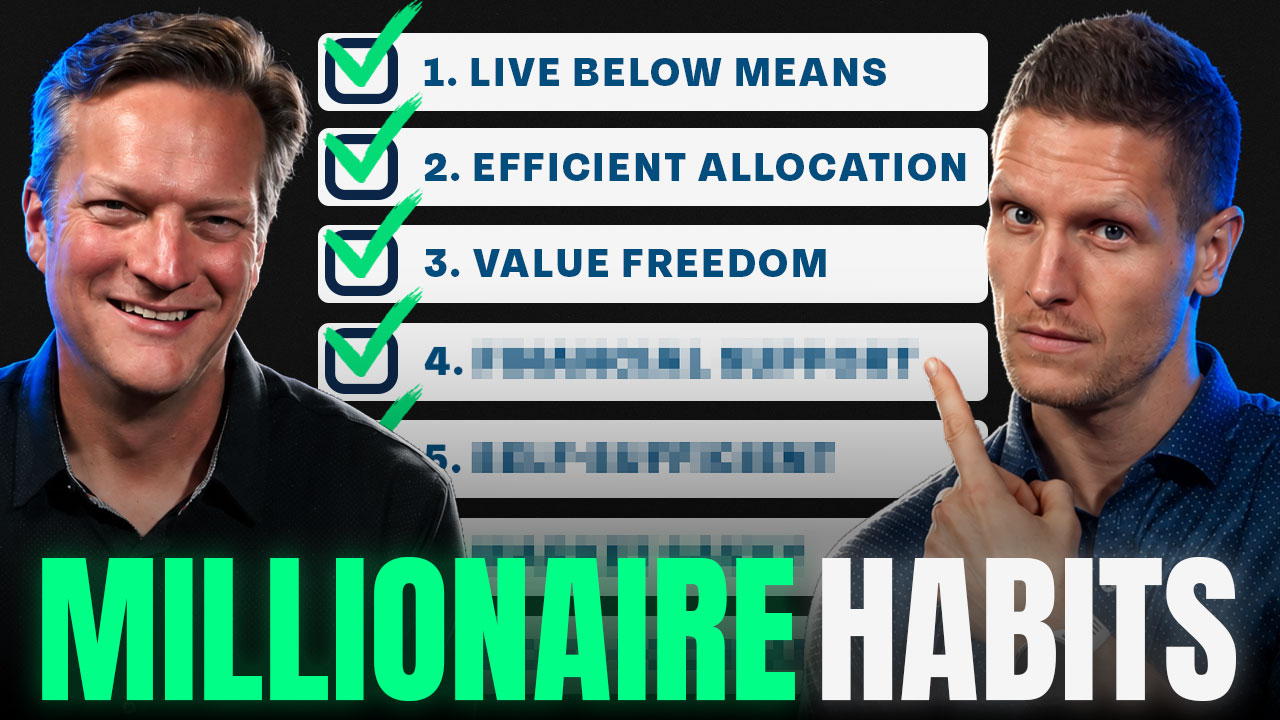
We don't want no scrubs! In this special livestream, we break down 7 habits of wealth builders and everyday millionaires - from living below your...
Episodes
They Want to Retire Early. Their Lifestyle Says Otherwise.
Can this couple retire early while traveling, raising kids, and enjoying their money today? Gina and Jaime want to retire early, but we show them...

Episodes
If You’re Between 32 and 48, Don’t Screw This Up
Rising income, compound growth, peak career years. In this new episode, discover why 32-48 could be the most powerful decade for building wealth and how...